Key Features
- Shell and tube design
- High heat transfer efficiency
- Borosilicate glass construction
- Industrial grade performance
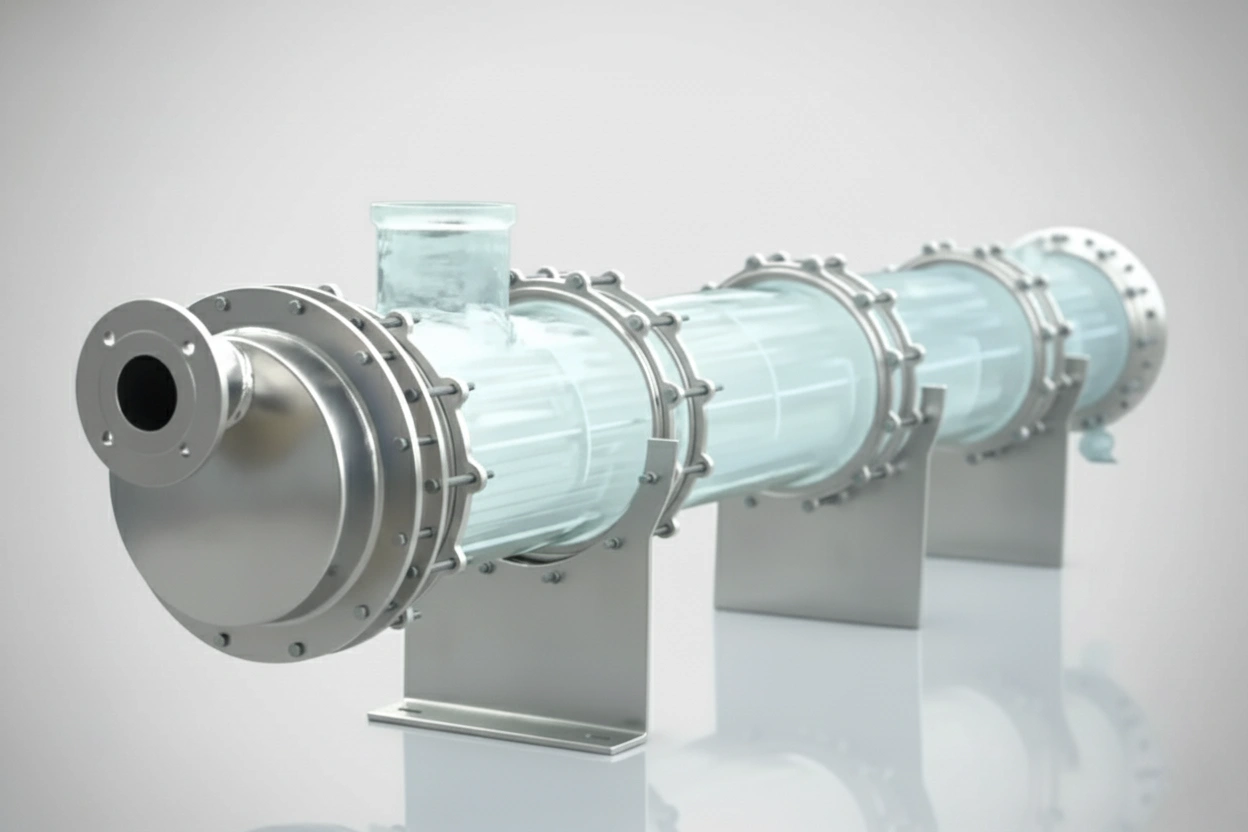
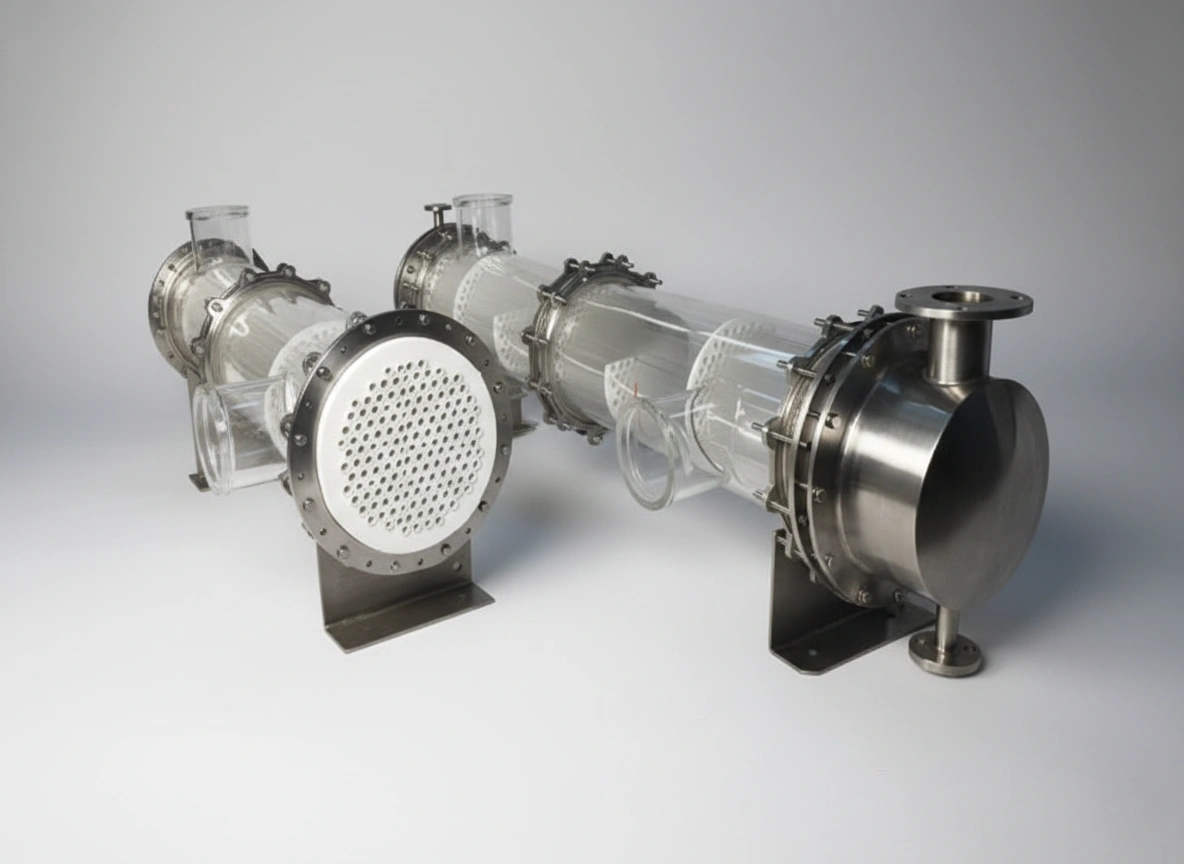
Shell and tube heat exchanger for industrial heat transfer applications.
Goel Scientific designs glass shell-and-tube heat exchangers that deliver high heat transfer efficiency, corrosion resistance, and adaptability for chemical and industrial applications . Compared to coil-type designs, these units offer greater overall heat transfer coefficients (up to ~3×) and lower pressure drops, making them well suited for demanding process duties . Their modular design supports custom scaling, ease of maintenance, and robust performance in harsh chemical environments .
Design and operating specifications for Goel’s glass shell-and-tube heat exchangers include:
– **Design Types**: RGG (glass/glass/glass), RGM (glass tube, non-aggressive shell), RMG (non-glass shell, glass tube)
– **Overall Heat Transfer Coefficient (U)**: Higher by factor ~3 relative to coil designs
– **Pressure Drop**: Low shell-side pressure drop; coil-type competitors may incur 2–3 kg/cm² drop on coil side
– **Mechanical Construction**: PTFE sockets & ferrule-type seals, baffles for turbulence enhancement, joint-less tubes for pressure rating
– **Dimensional Range**: Tube counts (e.g., 37, 73, 151), shell diameters (e.g. DN150, DN225, DN300), lengths up to ~4.5 m, baffle numbers from 7 to 23 depending on design
– **Temperature & Pressure Limits**: Typical working temp difference up to 120 °C; pressures, e.g. shell/tube sides up to 2–3.5 kg/cm² depending on model
– **Materials**: Borosilicate glass tubes, PTFE/packing seals, structural frames in SS or FRP, options for shell materials when required
Shell-and-tube heat exchangers by Goel are used in:
– **Cooling and heating duties** in chemical, pharmaceutical, and process industries where corrosive fluids are involved
– **Condensation and evaporation** duties, especially in systems requiring precise thermal control and vacuum compatibility
– **Aggressive chemical processes** (acidic, halogenated, etc.) where glass wetted parts offer better longevity than metals
– **Compact installations** needing high heat transfer area in constrained spaces, by leveraging modular tube bundles and optimized HTAs
– **Systems requiring maintenance and modular repairability**, since tubes can be replaced individually without discarding the full shell structure