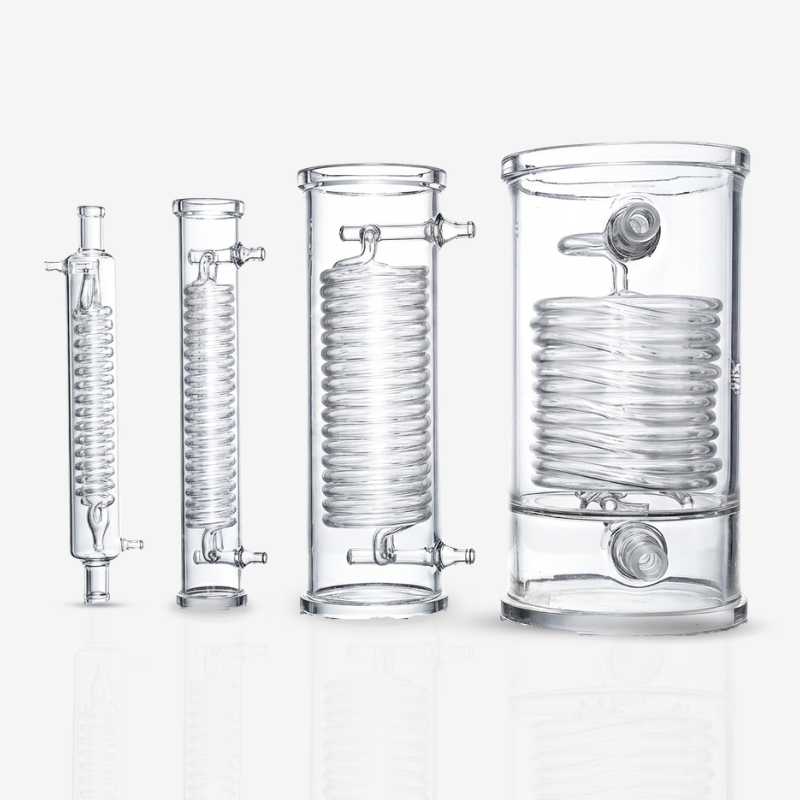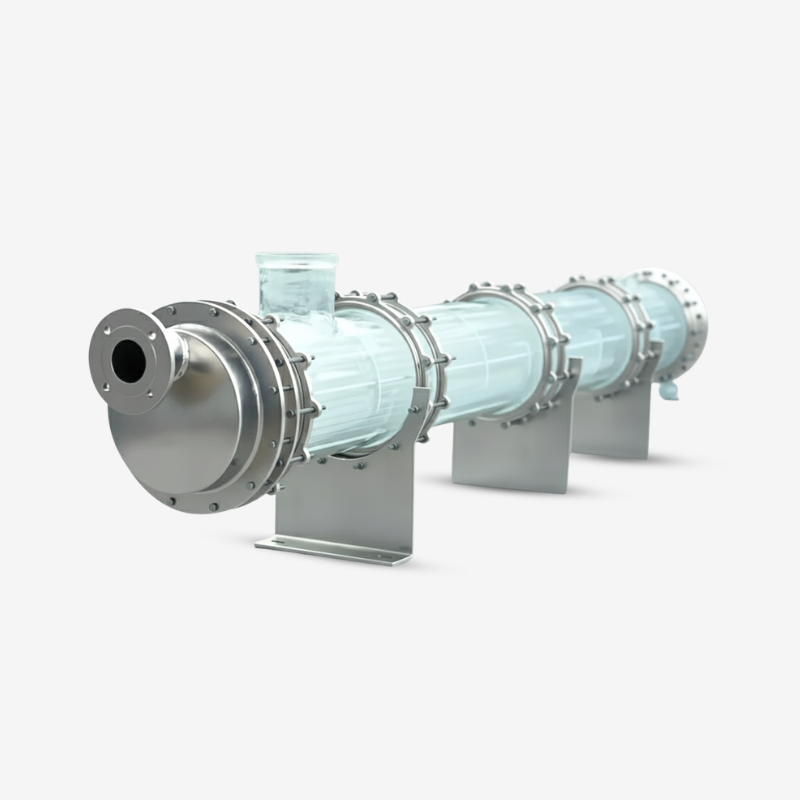


A glass heat exchanger is a process apparatus that transfers heat between two fluids while keeping them physically separated, fabricated from borosilicate 3.3 glass instead of stainless steel or other metals. Glass heat exchangers are preferred for corrosive, high-purity, and pharmaceutical grade duties because borosilicate is universally corrosion resistant, contributes zero metal contamination, and is fully transparent.
Goel Scientific manufactures three families of glass heat exchangers. Shell and tube designs cover heat transfer areas from 0.6 to 50 square metres in five subtypes optimised for different pressure and corrosion combinations. Coil-type heat exchangers (also known as coil condensers) are an all-glass single-piece construction for vapour condensation duties. Graphite shell and tube exchangers are specified for hydrofluoric acid and concentrated hydrochloric acid services where borosilicate is not suitable.
Shell and tube heat exchangers transfer heat between a process fluid flowing inside a bundle of glass tubes and a service fluid flowing in the surrounding glass or metal shell. Goel’s shell and tube range covers heat transfer areas from 0.6 to 50 square metres, supports both single and multi pass (up to 4 pass) configurations, and is available in five design variants (Type I to Type V) covering both side and single side corrosion resistance, plus high pressure modifications. Pressure rating: up to 6 bar gauge. Temperature: negative 40 to positive 200 degrees Celsius continuous.
Coil condensers consist of a glass coil battery welded into an outer glass jacket, forming an all glass one piece unit with no internal sealing problems. They are used primarily for vapour condensation and cooling of low viscosity liquids, and represent the lowest capital expenditure glass heat exchanger option. Heat transfer area: 0.05 to 5 square metres. Pressure: up to 1 bar gauge. Temperature: negative 20 to positive 200 degrees Celsius. Available in horizontal and vertical mounting and as part of distillation, reactor, and rotary evaporator assemblies.
Where service involves hydrofluoric acid, concentrated hydrochloric acid, or other media that attack borosilicate glass, Goel offers graphite tube shell and tube heat exchangers. Tubes are made of impregnated graphite (chemically resistant to almost all acids and alkalis) and are housed in a glass or PTFE lined steel shell. Heat transfer area: 1 to 100 square metres. Pressure: up to 6 bar gauge.
Goel manufactures five design variants of the shell and tube heat exchanger. The choice between Type I, II, III, IV, and V depends on which side of the heat exchanger sees the corrosive medium and on whether high-pressure operation is required.
| Type | Construction | Pressure Rating | Typical Service |
| I | Both shell and tubes are borosilicate; PTFE tube sheet and gaskets | 1 bar gauge | Universal duty: condensation, heat recovery, cooling on both sides |
| II | Borosilicate shell, mild steel or stainless steel headers; multi pass on header side | 3.5 bar gauge | Cooling and condensation of corrosive process fluid where utility side is non corrosive |
| III | Metal shell, borosilicate tubes and headers | 3.5 bar gauge | Cooling of corrosive process fluid in tubes; non corrosive utility on shell side |
| IV | Type II construction with reinforcing plate (high tube side pressure) | 6 bar gauge (tube side) | Same as Type II at higher tube side pressure |
| V | Type III construction with reinforcing plate (high shell side pressure) | 6 bar gauge (shell side) | Rapid cooling of corrosive media; falling film evaporator service |
Standard specifications across the Goel heat exchanger range:
| Parameter | Range / Specification |
| Heat transfer area | 0.6 to 50 square metres (single unit); larger duties banked |
| Tube material of construction | Borosilicate 3.3 / Silicon Carbide / Graphite / Hastelloy on request |
| Shell material of construction | Borosilicate 3.3 / Mild Steel / SS 304 / SS 316 / PTFE lined / Glass lined |
| Operating pressure | Negative 1 bar gauge to positive 6 bar gauge (depending on design) |
| Operating temperature | Negative 40 to positive 200 degrees Celsius continuous; positive 300 degrees peak |
| Maximum delta T between media | 70 degrees Celsius (higher available with thermal shock testing) |
| Tube count | 7, 19, 37, 61, 91, 127 (custom available) |
| Process connections | DN25, DN40, DN50, DN80, DN100, DN150, DN200, DN300 |
| Flow configuration | Single pass, 2 pass, 3 pass, 4 pass |
| Documentation | IQ/OQ protocols, MTC, Certificate of Conformity, dimensional inspection, polariscope strain report |
| Certifications | ISO 9001:2015 manufacturing; cGMP compatible; ASME equivalent design |
Indicative k-value performance for the most common fluid pairings:
| Application | Fluid Pair | k-value Glass / Glass (Kcal per square metre per hour per Kelvin) | k-value SiC (Kcal per square metre per hour per Kelvin) |
| Liquid / Liquid | Water to Water | 275 to 475 | 550 to 1,500 |
| Liquid / Liquid | Water to Organics | 250 to 400 | 400 to 1,200 |
| Liquid / Liquid | Water to Heat Transfer Oil | 175 to 350 | 350 to 700 |
| Liquid / Gas | Water to Air | 10 to 75 | 10 to 75 |
| Liquid / Vapour | Water to Water | 450 to 550 | 1,200 to 2,500 |
| Liquid / Vapour | Water to Organics | 350 to 500 | 750 to 1,800 |
Goel glass heat exchangers are in service in:
| Attribute | Glass HX (Goel) | Stainless / Hastelloy / Tantalum |
| Corrosion resistance | Universal across acids, alkalis, halogens | Material specific; HF service requires Tantalum |
| Process visibility | Fully transparent for real time inspection | Opaque; requires sight glasses |
| Capital expenditure | 40 to 70 percent lower than Tantalum | High, especially for exotic alloys |
| Cleaning frequency | Smooth bore, long mean time between cleans | Higher fouling rate |
| Contamination risk | Zero metal pickup | Trace metal pickup, problematic for pharmaceutical use |
| GMP suitability | Inert glass and PTFE in product contact | Requires polishing, passivation, and regular inspection |
| Pressure ceiling | Up to 6 bar gauge | 10 plus bar gauge |
| Thermal shock tolerance | Limited; delta T 70 degrees Celsius | Wider tolerance |
Glass heat exchangers are the right choice for corrosive, GMP critical, low fouling, and visually inspected service. Metal alloys are preferred where pressures exceed 6 bar gauge or where thermal shock cycles are aggressive.
A glass heat exchanger is a process apparatus that transfers heat between two fluids using borosilicate 3.3 glass instead of metal. It is preferred for corrosive, high purity, and pharmaceutical grade duties because glass is universally corrosion resistant, contributes zero metal contamination, resists fouling, and is fully transparent.
The two main types of glass heat exchanger are coil type (coil condenser) and shell and tube. Goel also manufactures graphite shell and tube heat exchangers for hydrofluoric acid and concentrated hydrochloric acid service. Shell and tube designs are further available in five variants (Type I to Type V) for different pressure and corrosion combinations.
A coil condenser uses a single glass coil welded into a glass jacket. It is simple, low cost, and ideal for vapour condensation up to about 5 square metres of heat transfer area. A shell and tube heat exchanger uses a tube bundle inside a shell, supports higher area (up to 50 square metres), higher pressure (up to 6 bar gauge), and multi pass configurations.
Goel manufactures glass shell and tube heat exchangers from 0.6 to 50 square metres and coil condensers from 0.05 to 5 square metres. For larger duties, multiple units can be banked in parallel or series with a single inlet and outlet manifold.
Standard glass shell and tube heat exchangers operate up to 1 bar gauge. Reinforced designs (Type IV and Type V) support up to 6 bar gauge on either tube or shell side. Vacuum operation down to negative 1 bar gauge is supported across all designs.
Continuous service from negative 40 to positive 200 degrees Celsius. Peak: up to 300 degrees Celsius. Maximum allowable delta T between media: 70 degrees Celsius in standard designs. Higher delta T is available with thermal shock testing on request.
Yes. Goel's glass heat exchangers are fully cGMP compatible. Only borosilicate 3.3 glass and PTFE are in product contact. Documentation pack includes Material Test Certificates, Certificate of Conformity, IQ/OQ protocols, polariscope strain report, and dimensional inspection report.
Glass shell and tube heat exchangers are used as condensers, coolers, heaters, reboilers, and vaporisers in pharmaceutical, specialty chemical, agrochemical, food, petrochemical, and pilot plant applications. They are specified where the service fluid is corrosive, the process is GMP regulated, or visual inspection of the process is required.
Yes. With minor modification, Type I and Type V shell and tube heat exchangers can serve as falling film absorbers or evaporators. Goel also manufactures dedicated falling film absorber units used in HCl absorption and SO3 absorption services.
Tubes: Borosilicate 3.3 (default), Silicon Carbide, impregnated graphite, Hastelloy C 276 on request. Shell: Borosilicate 3.3, mild steel, SS 304, SS 316, PTFE lined, glass lined. Tube sheet: PTFE with optional metal reinforcing plate. Gaskets: PTFE or Viton envelope.
Standard designs in stock sizes ship in 4 to 6 weeks. Custom-engineered units typically ship in 8 to 12 weeks from receipt of approved drawing. Express manufacturing is available on request for time-critical projects.
Yes. Goel exports glass heat exchangers to over 50 countries with full export documentation, foam cradled crating, and full container or less than container load shipping. Installation supervision, commissioning support, and operator training are available on a chargeable basis.