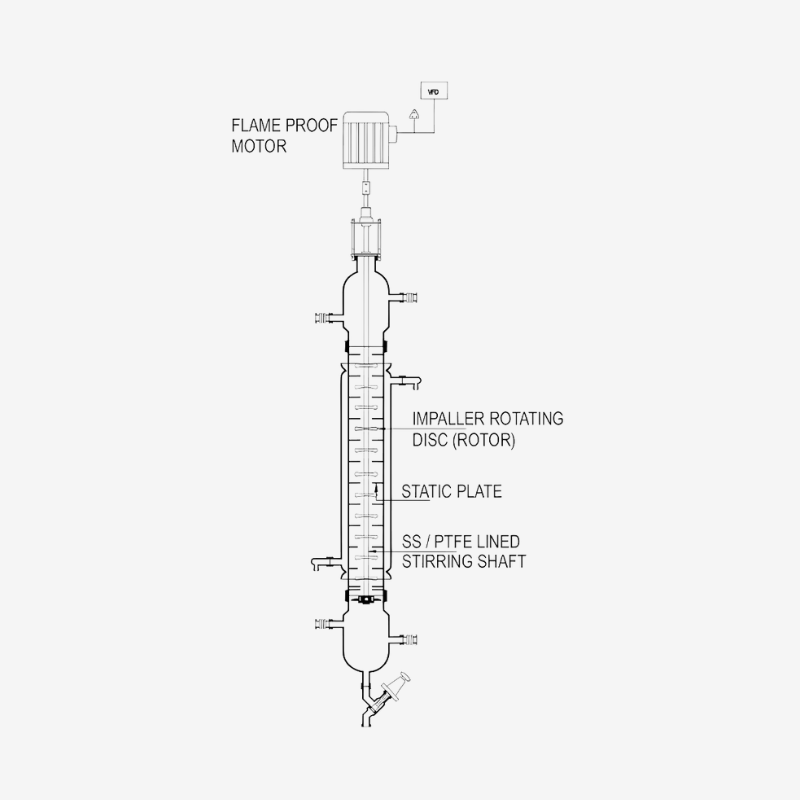
• Configuration: series of rotating discs and stationary baffles creating discrete extraction chambers
• Flow mode: countercurrent — heavy and light phases flow in opposite directions
• Materials: high-quality borosilicate glass for the column body; PTFE or corrosion-resistant wetted parts
• Operating temperature: ambient to moderate (depending on solvent)
• Pressure: near ambient to slight positive differential (lab-scale)
• Residence time: typically 20–30 minutes (adjustable via disc spacing and rotation speed)
• Capacity: lab to pilot scale (custom based on feed rate and required throughput)
• Utilities: drive motor for discs, feed pumps, phase separators, condenser if volatile components present
• Key design metrics: disc size & spacing, droplet coalescence control, minimal phase hold-up
The laboratory RDC uses glass construction to facilitate observation of droplet formation and liquid interface behavior, aiding design optimization.