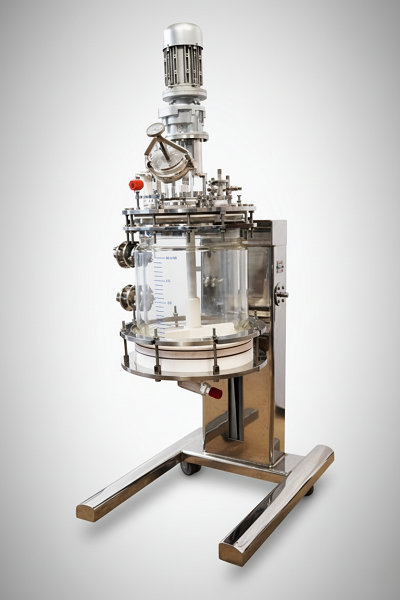
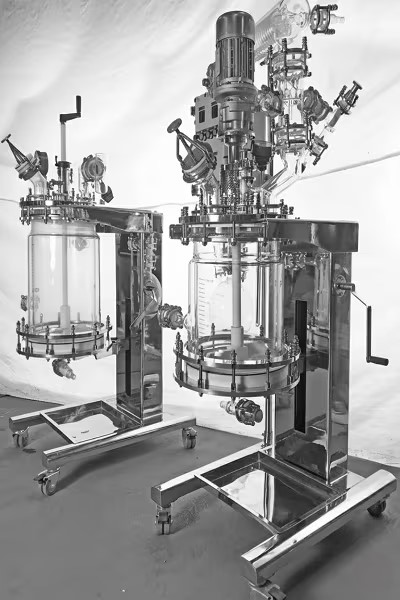
Available Configurations
• Non-Jacketed Glass Nutsche Filters: Up to 600 Liters
• Jacketed Glass Nutsche Filters: 5 to 500 Liters
Agitated Glass Nutsche Filters (ANF) for efficient solid-liquid separation through filtration and vacuum drying.
Agitated Glass Nutsche Filters (ANF), advanced laboratory and production units designed for efficient solid-liquid separation through filtration and vacuum drying. Widely used in chemical, pharmaceutical, and laboratory applications, these units provide reliable performance for both R&D and pilot-scale production. The Agitated Nutsche Filter Dryer (ANFD) integrates filtration and drying into a single, compact unit, enhancing operational efficiency. All wetted parts are made from inert materials—borosilicate glass and PTFE—allowing safe handling of a wide range of chemicals, solvents, and pharmaceutical compounds. During operation, slurry is introduced into the unit. Solid particles are retained by the filter medium, forming a filter cake, while the filtrate is collected through a bottom outlet valve. After processing, the filter cake is easily removed, making these units indispensable in industries such as herbal medicine, cosmetics, kilo-labs, agrochemicals, and food production.
• Non-Jacketed Glass Nutsche Filters: Up to 600 Liters
• Jacketed Glass Nutsche Filters: 5 to 500 Liters
Technical Specifications (10 L – 50 L)
• Capacity: 5 to 500 liters (Non-Jacketed / Jacketed) and 600-liter single-wall version
• Temperature: Up to 180°C
• Filter Cloth: Various mesh sizes and materials available on request
• Construction Material: Borosilicate glass and PTFE; custom configurations available to meet specific process requirements
• Full visibility of the filtration and drying process.
• Supports vacuum filtration for high-efficiency separation.
• Very high solvent recovery rates.
• Allows nitrogen sparging at ambient levels.
• Exceptional filtration efficiency.
• Safe operation with optional heat transfer surfaces for precise temperature control.
• Closed-system design prevents solvent vapors from escaping.
• Heating & Drying
• Solid-Liquid Separation
• Crystallization
• Filtration
• Chromatography
• Solid-Phase Peptide Synthesis (SPPS)