Key Features
- Glass lined reactor compatibility
- Complete assembly design
- Borosilicate glass construction
- Industrial grade components
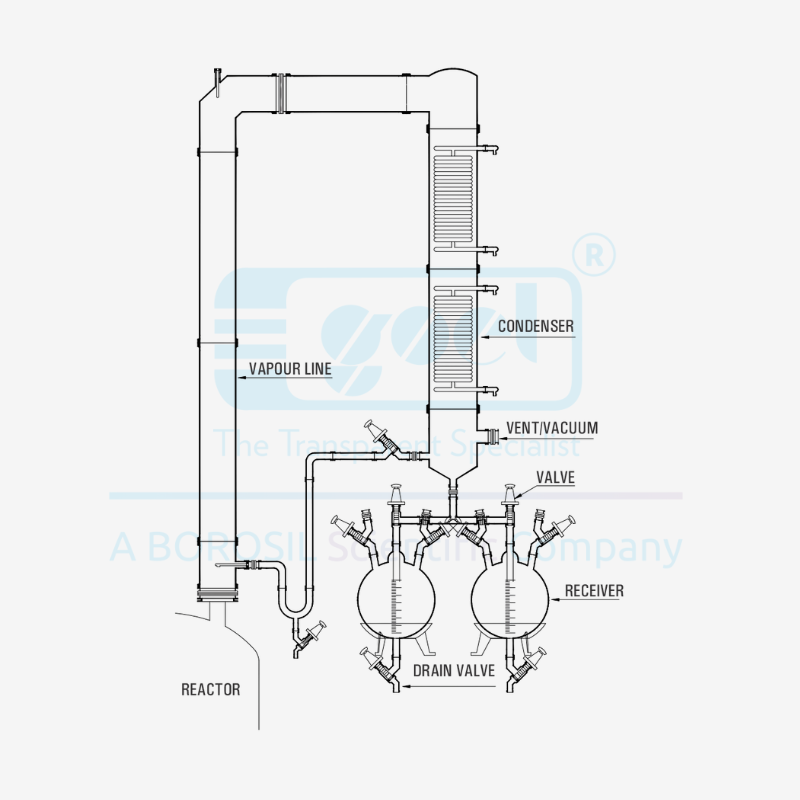
Complete assembly designed for glass lined reactor systems.
The “Assembly Over GLR” (Glass-Lined Reactor) refers to modular overhead units—such as distillation, reaction-distillation, or fractionation modules—that are mounted above a glass-lined reactor core when full glass reactors are impractical at large scale. The assemblies adopt similar functional elements (columns, heat exchangers, condensers, receivers), but often employ glass shell & tube heat exchangers to handle higher vapor loads and thermal duty. At large scale, the design shifts from coil condensers to shell & tube glass exchangers to meet performance needs. Typical assemblies include fractional distillation columns over GLR units of 250 L, 500 L, 1000 L, 2000 L, and 3000 L with matching vapor column dimensions and condenser heat transfer areas.
• Reactor capacities (GLR base): 250 L, 500 L, 1000 L, 2000 L, 3000 L
• Vapor column dimensions: e.g. Ø 80 mm × 1.5 m for 250 L; Ø 100 mm × 2 m for 500 L; Ø 150 mm × 3 m for higher GLRs
• Condenser heat transfer areas: e.g. 1.5 × 2 m², 2.5 × 2 m², 4.0 × 2 m² (depending on capacity)
• Pressure: typically atmospheric or vacuum
• Materials: borosilicate glass, glass-lined steel for the base vessel, PTFE wetted parts
• Operating temperature: up to ~200 °C
• Interfaces: standard nozzles, flanges, vapor lines compatible with GLR top connections
• Functional modules: often include shell & tube heat exchangers in place of coil condensers for better scaling
• Performing distillation directly atop glass-lined reactors to conserve footprint and simplify vapor routing
• Hybrid reaction + separation stacks in chemical processing
• Modularity in large chemical plants where full glass reactors are infeasible
• Integration of overhead assemblies (distillation, reflux, columns) with GLR bases
• Piloting or scale-up of processes requiring vapor handling above bulk reactors These assemblies extend glass compatibility into higher scale processes, preserving visual access and corrosion resistance while leveraging GLR’s structural strength and thermal capacity.