Key Features
- HCL absorption capability
- Adiabatic process design
- Borosilicate glass construction
- Corrosion resistant materials
Specialized HCL adiabatic absorption unit for hydrochloric acid absorption processes.
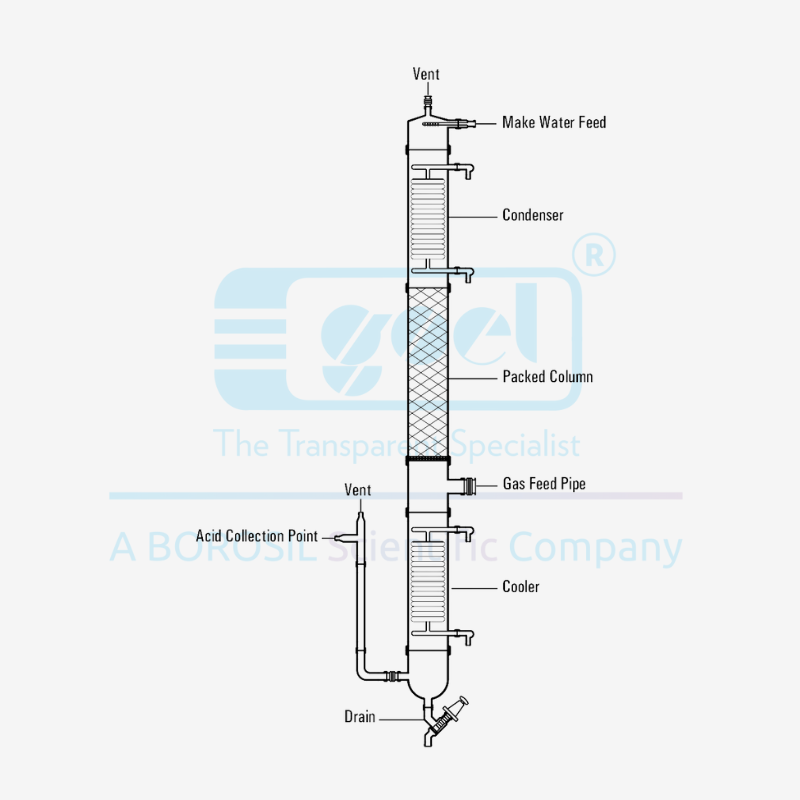
The HCl Adiabatic Absorption unit is designed to absorb gaseous HCl into water, converting it into hydrochloric acid. The system uses a packed absorption column where gas enters from the bottom while water is sprayed from the top. The column includes a condenser at the top and a cooler at the bottom to manage heat and maintain operational stability. Typical unit models include HCL3, HCL4, HCL6, HCL9, HCL12, differentiated by column dimensions, packed section lengths, and gas handling capacities.
• Models & specs: – HCL3: 80 mm × 3 m packed column; condenser HTA 0.35 × 2; gas rate ~10 kg/hr – HCL4: 100 mm × 4 m; HTA 0.5 × 2; ~20 kg/hr – HCL6: 150 mm × 4 m; HTA 1.5 × 2; ~60 kg/hr – HCL9: 225 mm × 4.5 m; HTA 2.5 × 2; ~150 kg/hr – HCL12: 300 mm × 4.5 m; HTA 4.0 × 2; ~300 kg/hr
• Materials: borosilicate glass, PTFE, corrosion-resistant supports
• Operating mode: adiabatic absorption with water spray, gas–liquid contact in packed bed
• Temperature control: condenser and cooler to manage absorption heat
• Flow: countercurrent liquid and gas flow
• Interfaces: feed gas inlet, acid collection outlet, water spray feed, cooling lines
• Pressure: near ambient with slight positive or negative differential depending on gas feed
• Capture of HCl emissions in chemical processes
• Production of aqueous hydrochloric acid from HCl gas streams
• Environmental control and gas scrubbing systems
• Pilot-scale absorption systems for acid gas handling
Because HCl cannot be vented directly, this unit enables safe containment and conversion of HCl gas into usable acid, suppressing atmospheric emissions.