Key Features
- Automated peptide synthesis
- Precise control systems
- Borosilicate glass construction
- High purity output
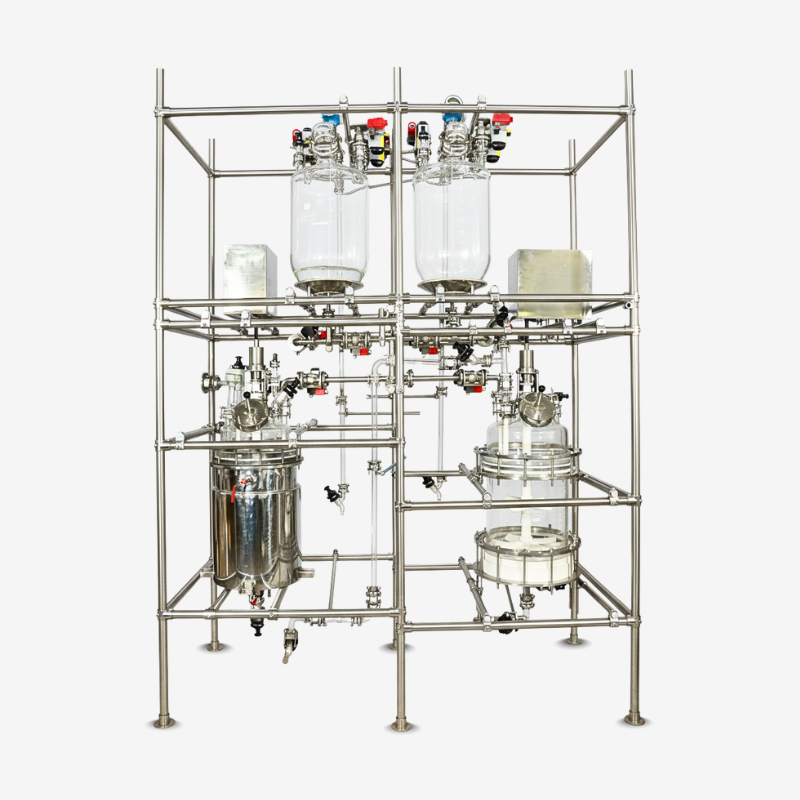
Specialized peptide synthesizer for automated peptide synthesis.
The Peptide Synthesizer is a glass/automated reactor platform for solid-phase peptide synthesis (SPPS). It typically comprises a reaction vessel with stirring, reagent feed lines, washing lines, deprotection lines, and filtration ports (often using nutsche or frit-based filtration). The system ensures precise reagent dosing, mixing, wash cycles, and solvent handling in a closed, inert environment. This unit enables repeatable peptide coupling and deprotection steps, fluid handling, and washing cycles under programmable control in research or pilot facilities.
• Reactor volumes: small to medium scale (e.g. 1 L – 50 L)
• Materials: borosilicate glass, PTFE/PEEK lines, inert joints
• Operating pressure: often slight vacuum or inert gas atmosphere
• Temperature: ambient to ~80 °C (typical SPPS conditions)
• Agitation: magnetic or mechanical stirrer
• Ports: multiple reagent, solvent, wash lines and valves
• Filtration: integrated frit or nutsche filtration interface
• Control: programmable reagent dosing, timing, and sequence automation
• Features: inert gas purge, sealing closures, reagent reservoirs, wash/waste lines
• Solid-phase peptide synthesis (SPPS) for research and scale-up
• Production of peptide intermediates and small peptides
• Synthesis of peptide libraries and custom peptide sequences
• Biochemistry, pharmaceutical R&D, and specialty chemical synthesis
• Automation of coupling, deprotection, and wash cycles
Its precise control over reaction and wash steps, combined with automated sequencing, makes it a key tool in peptide development workflows.