




Borosilicate Glass & Glassware built for Industrial Process Systems
High-performance borosilicate glass offering exceptional chemical resistance, thermal stability and durability.
Borosilicate Glass
We fabricate glass parts from the best raw materials from various leading manufacturers for their production.
On request, we also produce glass parts from a Leading European Borosilicate Glass 3.3 tubing supplier, which fulfils all major standards of DIN ISO 3585 & ASTM E438 Type I, Class A, and thus offer high accuracy & excellent optical properties, which is a part of other leading manufacturers across the globe.
Borosilicate Glass 3.3 is the most reliable and standardized material for constructing plant equipment and pipeline systems across the chemical, dyestuff, food processing, pharmaceutical, and petrochemical industries.
Key Features & Advantages of Borosilicate Glassware
- Outstanding corrosion resistance against acids, alkalis, and chemical solvents
- Excellent thermal shock resistance with low thermal expansion
- Smooth, pore-free surface preventing contamination and residue buildup
- High transparency for easy process monitoring
- Catalytically inertness – does not interfere with chemical reactions
- No impact on the taste and odour of processed materials
- Physiologically inertness and non-toxic
- Long service life with minimal maintenance
Borosilicate glass is widely preferred in industrial applications due to its exceptional chemical durability and thermal stability. It is engineered using a carefully controlled composition of high-purity oxides, primarily Silica (SiO₂) and Boron Oxide (B₂O₃), along with selected modifiers that enhance strength, resistance, and performance under demanding conditions.
The chemical and physical characteristics of borosilicate glass are directly influenced by its precise composition, making it highly reliable for process industries, laboratories, and chemical handling systems.
Chemical Composition
| SiO2 (Silicon Dioxide) | 80.6% |
| B2O2 (Boron Trioxide) | 12.5% |
| Na2O (Sodium Oxide) | 4.2% |
| Al2O3 (Aluminium Oxide) | 2.2% |
Resistance to Chemicals
Borosilicate glass is highly resistant to most chemicals and remains inert when exposed to the majority of acids, alkalis, and organic substances. However, it is not resistant to hydrofluoric acid (HF), phosphoric acid (H₃PO₄), and hot, concentrated caustic solutions. Among these, hydrofluoric acid has the most severe effect and can attack borosilicate glass even at very low concentrations measured in parts per million (PPM).
Phosphoric acid and caustic solutions generally do not affect borosilicate glass at ambient temperatures. However, at elevated temperatures, corrosion may occur depending on concentration and operating conditions. Caustic solutions with concentrations up to 30% can typically be handled safely at normal room temperature.
Under actual process conditions, factors such as temperature, turbulence, pressure, and the presence of trace contaminants can influence the rate of chemical attack. Therefore, exact corrosion rates for caustic solutions cannot be universally defined and should be evaluated based on specific operating environments.
PHYSICAL AND THERMAL PROPERTIES
Linear coefficient of thermal expansion:
The coefficient of thermal expansion of borosilicate glass over the temperature range
0–300°C is 3.3 × 10⁻⁶/°C. This is very low when compared with other glasses and metals. That is why, borosilicate glass is often called low-expansion borosilicate glass.
Specific Heat:
Specific heat between 25°C and 300°C is average to be 0.233 Kcal/kg·°C
Thermal Conductivity:
Thermal conductivity is 1.0 Kcal/hr·m·°C. Over the permissible operating temperature range.
Mean Specific Heat:
Mean specific heat capacity between 20 °C and 200°C is 0.98 KJ/Kg K.
GENERAL CLEANING
Annealing of glass is the process where the glass is heated and kept for a defined period of time to relive internal stresses. Careful cooling under controlled conditions is essential to ensure that no stresses are reintroduced by chilling/cooling.
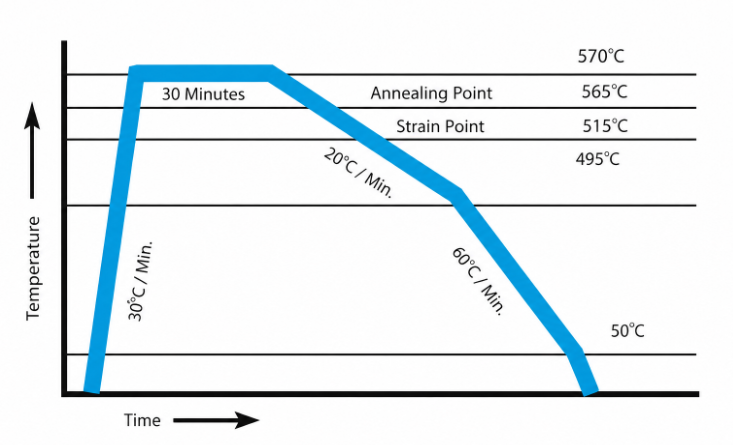
Instruction
Please Don’t Accept The Pipe Section With Thermal Stress (Various Colours Shades When Seen Through polarimeter).
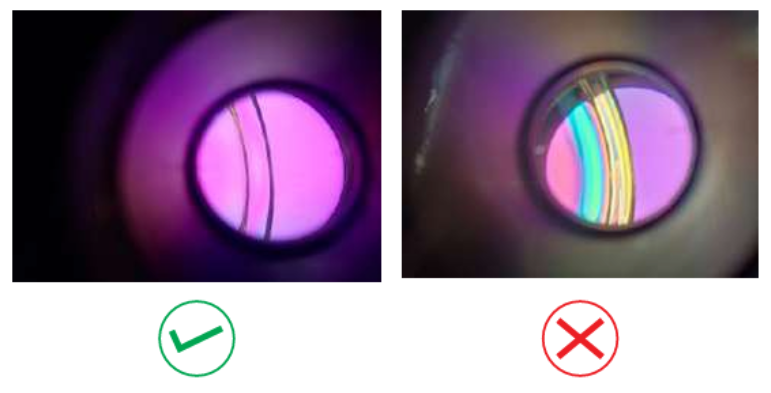
RESHAPING
| Lower cooling temperature | 1024 poise | 515°C |
| Upper cooling temperature | 1013 poise | 565°C |
| Softening point | 107 poise | 795°C |
| Reshaping point | 104 poise | 120°C |
MECHANICAL PROPERTIES
The lack of ductility of glass prevents the equalization of stresses at local irregularities or flows, and the breakage strength varies considerably about a mean value. This latter is found to occur at a tensile strength of about 700 kg/cm². In order to allow for the spread of breaking stress, a large factor of safety is applied when determining the wall thickness requirement to allow operation up to values given in the table of working pressure.
OPTICAL PROPERTIES
Borosilicate glass shows no appreciable absorption in the visible region of spectrum and therefore appears clear and colorless.
In photo chemical processes, the transparency of ultraviolet (UV) is of particular importance. It follows from the transmittance of material in uv region that photo chemical reactions such as Chlorination & Sulpho-chlorination can be performed in it.
PERMISSIBLE OPERATING CONDITIONS
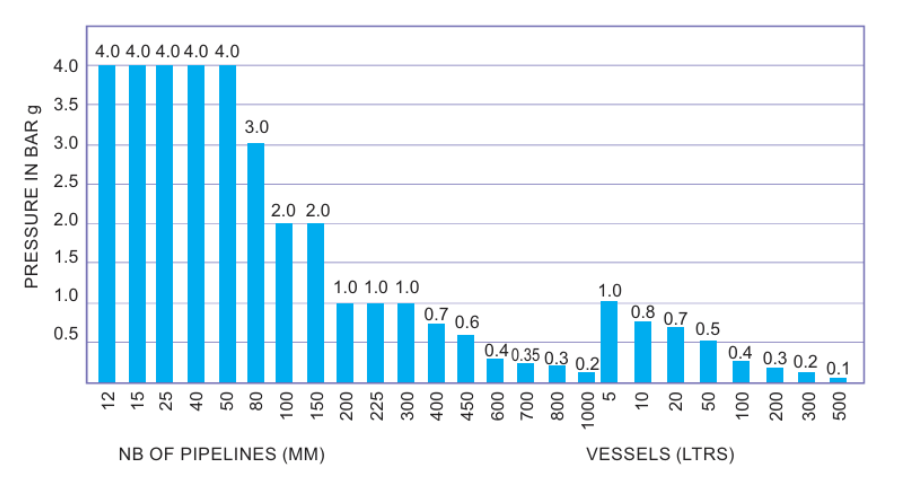
Working Pressure For Glass Pipelines & Vessels
The permissible internal operation pressure depends upon the nominal diameter of the glass components and on working temperature.
In case of unit with various combination like vessels, filters, heat exchangers, the over all permissible internal gauge pressure is always governed by the component with the lowest permissible operating gauge pressure all components are suitable for full vacuum.
Bar is a measure of absolute pressure. The figure given for maximum recommended working pressure represents pressure above atmospheric.
Working Temperature
Borosilicate glass retains its mechanical strength and will deform only at temperature which approach its strain point. The practical upper limit for operating temperature is much lower and is controlled by the temperature differentials in the glass which depends on the relative temperature of the contents of the equipment and the external surroundings. Provided borosilicate glass is not subject to rapid change in temperature, creating undue thermal shock, it can be operated safely at 0 temperatures up to 250 °C.
It must be realised that in complete plants, composed not only of borosilicate glass, but also include other materials such as PTFE. The 0 recommended max. The operating temperature is 200 °C. Operating temperatures may have to be modified so as to compensate for the effects of other factors such as pressure, thermal cycling, rapid heating & cooling, etc.
The degree of thermal shock (usually defined as sudden chilling or heating) that it can withstand depends on many factors, such as stresses due to operating conditions, stresses imposed in supporting the equipment, and the wall thickness of the glass. It is therefore undesirable to give sudden temperature changes. But up to 120 °C can be accommodated.
As sub-zero temperature, the tensile strength of borosilicate glass tends to increase and equipment can be used safely at temperatures as low as -50 °C for XTRONG and components.
Composite Materials
The last two decades have seen the new or further developments of particularly corrosion-resistant plant construction materials. Typical examples of these are PTFE, tantalum, titanium, graphite and of course, Borosilicate 3.3 Glass.
The combination of different corrosion-resistant materials, with the utilization of the specific advantages of each, permits both safe and economic construction.
Borosilicate glass with PTFE
Borosilicate Glass with PTFE is of particularly decisive importance for the construction of glass installations. For example, in Seals, Bellows, Stirrers, Pumps, Heat Exchangers, Column Inserts, etc.
PTFE is used with Glass because of its excellent mechanical & thermal properties. They have near-universal fluid compatibility. Wear life when compared with others is very low. Particularly, PTFE is maintenance-free and has cryogenic stability with a non-wetting property.
Service temperature of PTFE is considered as –50°C to +200°C.
ELECTRICAL CHARACTERISTICS
Glass being a poor electrical conductor, surface conductivity is insignificant and varies with the quantity of water absorbed on the glass surface. The specific conductivity is 10⁻⁶ ohm/cm at a temperature of 200 °C. The dielectric coefficient varies with current frequency.
Density of Borosilicate Glassware
Borosilicate glass is known for its excellent mechanical strength and dimensional stability, making it ideal for demanding industrial applications.
Density of glass at 20°C(J)=2.23g/cc
Modulus of elasticity (E)=6.3 KN/mm2
Poissions ratio=0.2
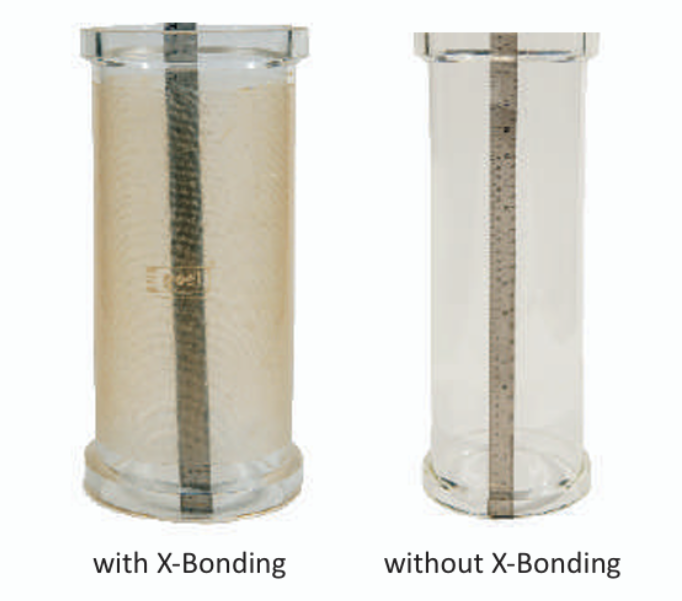
EXTRA PROTECTION OF GLASS COMPONENTS ‘X-BONDING’
X BONDING provide an added advantage of protection of standard glass components. The major advantage of X-Bonding systems is that if the glass is subject to accidental breakage, the bonded wrapping provides additional protection against the risk of injury, release of corrosive fluids or loss of expensive products.
X BONDING is a glass reinforced fibre coating which provide a higher level of protection on the glass components. This does have a slightly adverse effect on the transparency of the glass, making it translucent & not transparent.
Permissible Operating Temperature
The permissible operating temperature for X-Bonding is 130 °C unless limited by the individual operating temperature of the said component.
Permissible Operating Pressure
The permissible operating pressure for X-Bonded components is the same as that for Standard Glass Components.
Thermal Shock
Despite the thermal insulating effect of X-Bonding, the thermal shock characteristics remain the same as standard glass components.