




- Keyur Patel
- July 20, 2026
- Wiped Film Evaporator
- 0 Comments
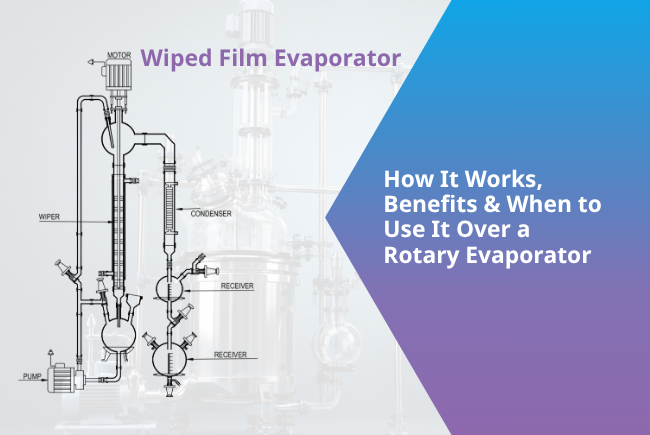
Wiped Film Evaporator: How It Works, Benefits & When to Use It Over a Rotary Evaporator
A wiped film evaporator is a continuous, short-residence thermal separation unit in which the feed liquid is mechanically spread into a thin film across a heated surface. Mechanical wiper blades sweep the surface, exposing fresh liquid for rapid evaporation while preventing fouling. The technology is widely used for heat-sensitive materials, highly viscous feeds, and processes where conventional batch evaporators struggle to achieve product quality.
Introduction to Wiped Film Evaporation Technology
Wiped film evaporation emerged in the chemical and pharmaceutical industries as a response to the limitations of batch and falling-film evaporators when handling heat-sensitive or viscous materials. The mechanical wiping action creates a controlled, uniform thin film, reducing both residence time and the temperature gradient between bulk liquid and heating surface. The result is gentler processing of compounds that would otherwise degrade. Today, wiped film evaporators are standard equipment in cannabinoid refining, fine chemical purification, and polymer devolatilisation.
What Is a Wiped Film Evaporator?
A wiped film evaporator is a vertical cylindrical vessel with a heated outer jacket and a centrally mounted rotor fitted with wiper blades. Feed is introduced at the top and distributed onto the inner wall, where the rotor blades spread it into a thin film and continuously renew the surface. Vapours released from the film flow either upward to a top condenser or downward to an internal condenser depending on design. The non-evaporated residue collects at the bottom for further processing or as product, and operation is continuous rather than batch-wise.
Wiped Film Evaporator Principle Explained
The principle behind wiped film evaporation is that vaporisation rate is governed by the heat-transfer coefficient and by the temperature driving force across the liquid film. By keeping the film thin and renewing it mechanically, both factors are maximised at the same time. The wiper blades sweep liquid across the heated surface at high frequency, breaking the thermal boundary layer and exposing fresh material continuously. Combined with reduced pressure operation, this produces high evaporation rates at temperatures well below the atmospheric boiling point of the feed.
Wiped Film Evaporator Working Principle: Step-by-Step
- Feed enters the top of the evaporator and is distributed evenly onto the heated cylindrical wall.
- The rotor, fitted with wiper blades, spreads the feed into a thin uniform film across the surface.
- Heat is transferred from the jacket through the wall to the film, causing rapid evaporation of volatile components.
- Wiper blades continuously sweep the surface, renewing the film and preventing localised overheating or fouling.
- Vapour disengages from the film and flows to an internal or external condenser, where it is captured as distillate.
- The non-evaporated heavy residue moves downward along the wall and is discharged at the base as the concentrate.
Key Benefits of Wiped Film Evaporator Systems
- Short residence time, typically a few seconds to under a minute, which protects heat-sensitive compounds.
- Operation at low temperature under deep vacuum, reducing thermal stress on the product.
- High evaporation rates per unit heat transfer area thanks to mechanical film renewal.
- Capability to handle viscous and fouling feeds that block conventional falling-film units.
- Continuous operation suitable for both pilot-scale and production-scale duties.
- Clean separation of high-boiling residues from valuable distillate fractions.
- Compact footprint compared with conventional batch evaporation plant.
Wiped Film Evaporator vs Rotary Evaporator
The two technologies share the same goal of solvent removal under vacuum but differ in scale, residence time, and continuity of operation.
| Parameter | Rotary Evaporator | Wiped Film Evaporator |
|---|---|---|
| Mode of operation | Batch | Continuous |
| Typical scale | Laboratory and pilot | Pilot to full production |
| Residence time | Minutes to hours | Seconds to under a minute |
| Suitability for viscous feed | Limited | Excellent |
| Heat exposure | Moderate | Minimal |
| Throughput | Low to medium | High and continuous |
Industrial Uses of Wiped Film Evaporators
Wiped film evaporators are deployed across industries that handle heat-sensitive, viscous, or high-value materials.
- Pharmaceutical concentration of active ingredients without thermal degradation.
- Cannabinoid distillation and refining of essential oils.
- Polymer devolatilisation to remove residual monomers from finished resins.
- Concentration of natural extracts in food and flavour processing.
- Recovery of high-boiling solvents from chemical reaction mixtures.
- Purification of fatty acids and tocopherols in oleochemical processing.
Types of Wiper Blades and Rotor Designs
Wiper geometry is selected to suit the feed viscosity, fouling tendency, and process conditions. Fixed-clearance metal blades offer durability for continuous operation, while hinged or sprung blades adapt to thermal expansion and uneven surfaces. Roller-wiper designs are used for feeds prone to crystallisation. Materials of construction range from PTFE inserts for chemical compatibility to high-grade alloys for elevated-temperature service. The choice of rotor design has a direct effect on film thickness, energy consumption, and the long-term reliability of the unit.
Factors to Consider Before Investing in a Wiped Film Evaporator
Selecting a new or used wiped film evaporator is a decision that combines process chemistry, throughput requirements, and capital constraints. The feed viscosity profile across the operating temperature range determines wiper design and motor sizing. Vapour load defines condenser duty and pump capacity, while the boiling-point range of the components sets the required vacuum level. Materials of construction must withstand the feed chemistry over thousands of operating hours. For pre-owned equipment, the condition of the wiper blades, the jacket, and the mechanical seal should be inspected carefully before purchase.
Maintenance Tips for Long-Term Efficiency
- Inspect wiper blades for wear and replace at manufacturer-recommended intervals.
- Monitor motor current draw for early signs of viscosity changes or fouling.
- Check the mechanical seal regularly for vacuum integrity and leak tightness.
- Clean the heating jacket and the internal surfaces between batches when processing varied feeds.
- Verify temperature sensor and pressure transmitter calibration on a routine schedule.
- Service the vacuum system, including pumps and traps, in line with the system duty cycle.
- Maintain wear records and spares inventory to minimise unplanned downtime.
Why Precision Engineering Matters in Wiped Film Systems
Wiped film evaporator performance is governed by the precision of the rotor, the uniformity of the heated wall, and the integrity of the vacuum envelope. A small misalignment in the rotor produces uneven film thickness, hot spots, and accelerated wear of the wipers. Goel Scientific Glass Works Ltd. designs and fabricates industrial wiped film evaporators with borosilicate 3.3 glass bodies, precision-engineered rotor assemblies, and qualified vacuum systems. Each unit is built to client process data and tested for thermal performance and mechanical reliability before despatch.
Conclusion: Optimising Thermal Separation with the Right Equipment
Wiped film evaporators bridge the gap between laboratory rotary evaporators and large-scale industrial distillation columns. Where heat-sensitive, viscous, or high-value feeds need to be concentrated continuously and gently, the technology has no real equivalent. Choosing a unit that matches the process chemistry and throughput requirement is what determines whether the investment delivers consistent product quality over a service life measured in years rather than months.
Frequently Asked Questions
FAQs
1. Can wiped film evaporators handle highly viscous materials?
Yes. The mechanical wiping action is what enables the technology to process feeds with viscosities up to several hundred thousand centipoise, well beyond the range of falling-film or thin-film evaporators that rely on gravity flow alone.
2. How does Goel Scientific ensure quality and reliability?
Each Goel Scientific wiped film evaporator is built from certified borosilicate 3.3 glass with precision-engineered rotor assemblies. Units are tested for thermal performance, vacuum integrity, and mechanical operation before despatch, and are supplied with full material and inspection documentation.
3. What is the typical lifespan of a wiped film evaporator?
A well-maintained wiped film evaporator operates reliably for 15 to 20 years or longer. The glass body and the heated wall remain effectively unchanged over this period. Wear components such as wiper blades and the mechanical seal are replaced on a routine schedule and do not affect overall service life.
4. Are custom sizes available for different production scales?
Yes. Wiped film evaporators are routinely engineered for laboratory-scale duties at small heat-transfer area, through pilot units, and up to production-scale systems handling continuous feed at industrial throughput. Goel Scientific manufactures across this range to suit the specific application.
5. How energy-efficient are Goel Scientific wiped film evaporators?
Wiped film evaporators are inherently energy-efficient because the short residence time and high heat-transfer coefficient minimise the time the product spends at elevated temperature. Combined with efficient vacuum operation, energy consumption per kilogram of distillate is significantly lower than equivalent batch evaporation.
6. What safety standards do these evaporators comply with?
Goel Scientific wiped film evaporators are designed in line with applicable pressure vessel codes for vacuum service and with GMP requirements for pharmaceutical applications. Mechanical seal, motor, and instrumentation packages comply with relevant electrical and area classification standards as specified by the client.
