




- Keyur Patel
- July 22, 2026
- Rotary Evaporator
- 0 Comments
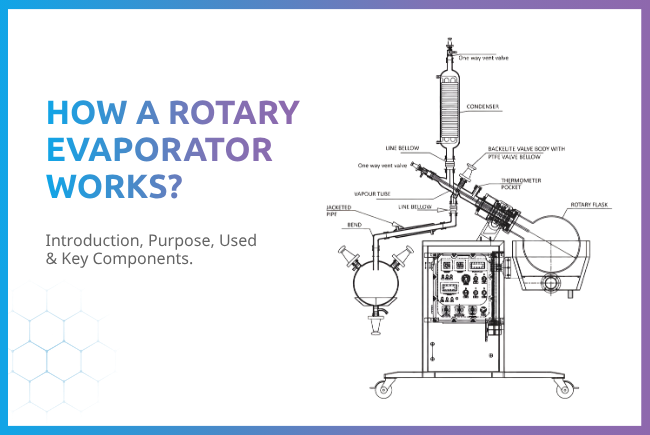
What is a Rotary Evaporator? How Do Rotary Evaporators Work?
To know what is a Rotary Evaporator technology is important for laboratories and industries involved in solvent recovery, sample concentration, and chemical processing. A Rotary Evaporator, often called a rotovap, is a device designed to remove solvents from samples through gentle vacuum-assisted evaporation. The flask rotates continuously inside a heated bath while the system operates under reduced pressure, allowing solvents to evaporate at lower temperatures. This makes the process highly effective for handling heat-sensitive compounds in pharmaceutical research, chemical synthesis, biotechnology, and industrial production.
Introduction to Rotary Evaporation Technology
Rotary evaporation is one of the most widely used techniques for solvent removal and sample concentration in laboratories and industrial facilities. It does what a rotovap does by combining vacuum pressure, controlled heating, and continuous flask rotation, Rotary Evaporators allow fast and gentle evaporation without damaging heat-sensitive materials. Today, these systems are used across pharmaceutical, chemical, biotechnology, food, and research industries.
What is a Rotary Evaporator?
A Rotary Evaporator, also called a rotary vacuum evaporator or rotovap, is a device designed to remove volatile solvents from liquid mixtures under reduced pressure. Lower pressure reduces the solvent’s boiling point, allowing evaporation at much lower temperatures.
The rotating flask creates a thin liquid film, which improves heat transfer and ensures uniform evaporation without local overheating. This makes Rotary Evaporators ideal for delicate compounds, natural extracts, and pharmaceutical materials.
What Does a Rotary Evaporator Do?
A Rotary Evaporator separates solvents from mixtures based on differences in volatility. During operation, the solvent evaporates first, condenses inside the cooling system, and is collected separately, while the concentrated sample remains in the evaporation flask. These systems are commonly used for:
- Solvent recovery
- Sample concentration
- Purification processes
- Essential oil and flavour extraction
- Drying suspensions and granules
Purpose of the Rotary Evaporator in Labs
Modern laboratories and industrial plants rely on Rotary Evaporators because they provide controlled and efficient solvent removal. Their ability to operate under full vacuum helps reduce boiling temperature and processing time, protecting sensitive compounds from thermal degradation. Industries that commonly use Rotary Evaporators include:
- Chemical and pharmaceutical manufacturing
- Biotechnology and life sciences
- Food and aroma processing
- Environmental and analytical laboratories
How Does a Rotary Evaporator Work?
To understand what a Rotary Evaporator do, you should know its working process:
- The sample is placed inside the rotating flask.
- The flask rotates continuously to form a thin liquid layer.
- A heated bath supplies controlled heat.
- Vacuum pressure lowers the solvent’s boiling point.
- Vapour moves into the condenser and cools into liquid form.
- The recovered solvent collects in a receiving flask.
The combination of thin-film evaporation and vacuum operation allows efficient solvent removal with minimal heat exposure.
What is a Rotary Evaporator Used For?
Rotary evaporators are used wherever a solute must be concentrated by removing the solvent under controlled conditions. The main use cases include:
- Concentration of reaction mixtures in organic synthesis laboratories.
- Solvent recovery in extraction processes for natural products and pharmaceuticals.
- Preparation of samples for analytical chemistry, including HPLC and NMR.
- Recycling of laboratory solvents to reduce procurement cost and waste disposal volume.
- Concentration of essential oils, plant extracts, and flavour compounds at low temperature.
- Industrial-scale solvent recovery and product concentration in pilot plant operations.
Key Components of a Rotary Evaporator System
A standard Rotary Evaporator system includes:
- Evaporation Flask: Holds the sample mixture
- Drive Motor: Controls flask rotation speed
- Heating Bath: Provides controlled heating
- Condenser: Converts vapour back into liquid
- Receiver Flask: Collects recovered solvent
- Vacuum System: Reduces internal pressure
High-quality systems often use Borosilicate 3.3 glass and PTFE seals for better corrosion resistance and long-term durability.
Rotary Evaporator vs Simple Distillation
Compared to simple distillation, Rotary Evaporators provide faster and safer evaporation. Vacuum operation lowers boiling temperatures, while continuous rotation reduces bumping and improves heat transfer.
| Parameter | Simple Distillation | Rotary Evaporator ▼ |
|---|---|---|
| Operating pressure | Atmospheric | Reduced (vacuum) |
| Evaporation surface | Static pot surface | Rotating thin film |
| Risk of bumping | High without boiling chips | Minimal due to rotation |
| Temperature exposure | Higher | Lower |
| Typical application | Bulk solvent recovery, water purification | Concentration of heat-sensitive samples |
This makes Rotary Evaporators better suited for heat-sensitive compounds and high-purity applications.
Safety and Maintenance Best Practices
Safe operation depends on regular maintenance and proper handling:
- Inspect glassware for cracks before use
- Vent the system before removing flasks
- Maintain vacuum seals and condenser cleanliness
- Monitor bath temperatures carefully
- Service vacuum pumps periodically
Routine maintenance improves equipment lifespan and operational safety.
Choosing the Right Rotary Evaporator
When selecting a Rotary Evaporator, important factors include:
- Flask capacity
- Vacuum control accuracy
- Automation features
- Material compatibility
- Production scale
At Goel Scientific Glass Works Ltd., we make laboratory, pilot-scale, and industrial Rotary Evaporators with capacities ranging from small benchtop units to large systems up to 400 litres. It includes features such as digital RPM and temperature control, automatic bath lifting, corrosion-resistant construction, and vacuum-compatible designs for demanding industrial applications.
Why Precision Equipment Matters in Evaporation
Solvent recovery is only as reliable as the equipment that performs it. Borosilicate 3.3 glassware, precision-fitted joints, and a well-engineered drive system make the difference between consistent recovery and persistent leakage problems. Goel Scientific Glass Works Ltd. manufactures industrial Rotary Evaporator systems and the associated glassware for laboratory, pilot, and production duties. Each unit is built from certified borosilicate glass to process client data and is tested before dispatch to ensure consistent thermal performance and long service life.
Looking for reliable and high-performance Rotary Evaporator systems for laboratory or industrial applications? Explore the advanced rotary evaporation solutions offered by Goel Scientific Glass Works Ltd.
Conclusion
Understanding what is a Rotary Evaporator is important because it applies mechanical thin-film evaporation under controlled vacuum. From discovery chemistry through to pilot-scale solvent recovery, well-specified Rotary Evaporators remain the most efficient means of concentrating samples without thermal damage. Investing in precision-engineered equipment is the simplest way to ensure reliable results across years of routine operation.
Frequently Asked Questions
(FAQs)
1. What solvents can be evaporated using a Rotary Evaporator?
Rotary evaporators are commonly used with solvents such as water, ethanol, methanol, acetone, hexane, and ethyl acetate. Higher-boiling solvents like DMSO and DMF can also be processed with stronger vacuum systems.
2. How does a vacuum improve the efficiency of rotary evaporation?
Vacuum lowers the solvent’s boiling point, allowing evaporation at lower temperatures. This improves efficiency and helps protect heat-sensitive materials.
3. Can a Rotary Evaporator be used for heat-sensitive compounds?
Reduced pressure, controlled heating, and continuous rotation make Rotary Evaporators ideal for pharmaceutical compounds, natural extracts, and other temperature-sensitive materials.
4. What maintenance is required for Rotary Evaporators?
Regular inspection of glassware, seals, condensers, and vacuum pumps is important for maintaining safe and efficient operation.
5. How does Goel Scientific ensure quality in its Rotary Evaporator systems?
Goel Scientific Rotary Evaporators are built with precision-engineered Borosilicate 3.3 glassware, corrosion-resistant components, and tested vacuum systems, all designed for reliable long-term performance.
6. Is rotary evaporation suitable for large-scale industrial use?
Industrial Rotary Evaporators are widely used for solvent recovery, product concentration, and pilot-scale production in pharmaceutical and specialty chemical industries.
