




- GOEL Scientific
- October 26, 2026
- High Pressure Reactor
- 0 Comments
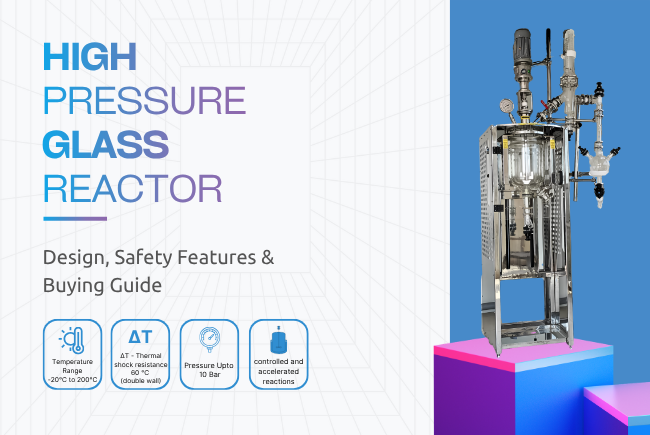
Imagine running a high pressure hydrogenation or catalytic synthesis, only for a sudden exotherm to cause an uncontrolled pressure spike. In chemical processing, operating under pressure speeds up reaction kinetics and improves gas-liquid absorption, but it also increases operational risk. Operating a high pressure reactor safely requires a balance of mechanical design, strict material selection and reliable safety controls. This reactor buying guide explains pressure vessel design principles, essential safety features and key factors to evaluate before investing in pressurised reaction equipment.
Fundamental Pressure Vessel Design Principles
Following proper pressure vessel design principles ensures the reaction container withstands internal stresses without mechanical failure. When designing a pressure reactor, engineers calculate wall thickness, head geometry and nozzle reinforcement using established engineering formulas.
- Hoop and Longitudinal Stress: Internal pressure exerts outward forces against the vessel walls. The wall thickness must resist both circumferential (hoop) stress and longitudinal stress.
- Aspect Ratio: The ratio of vessel height to internal diameter affects gas-liquid contact time, mixing efficiency and heat transfer surface area.
- Head Design: Ellipsoidal, hemispherical or torispherical dished heads distribute pressure stress more evenly than flat end plates.
- Nozzle and Port Reinforcement: Openings for stirrer shafts, sampling lines and instruments create stress concentrations that require local wall reinforcement.
Laboratory Pressure Reactor vs Pilot Plant Scale
Moving from a small laboratory pressure reactor to a full-scale pilot system requires adjusting heat transfer rates, agitation dynamics and pressure containment methods.
| Parameter | Laboratory Scale | Pilot Plant Scale |
| Volume Capacity | 50 mL to 5 L | 10 L to 100 L+ |
| Primary Purpose | Catalyst screening and R&D | Process validation and scale-up |
| Heat Transfer Area | Higher surface-to-volume ratio | Lower surface-to-volume ratio |
| Charging & Discharging | Manual port loading | Piping manifolds and controlled transfer |
| Mounting Structure | Bench-top stand | Skid-mounted support frame |
Material Selection: Stainless Steel, Hastelloy and Glass-Lined Steel
Selecting the right alloy or lining material prevents corrosion, avoids product contamination and maintains vessel strength across broad temperature ranges.
| Material | Max Pressure Limits | Corrosion Resistance | Thermal Transfer | Target Use Case |
| Stainless Steel (316L) | High (Up to 350+ bar) | Good for general organics | High | High pressure hydrogenations, oil processing |
| Hastelloy (C-276) | High (Up to 350+ bar) | Exceptional for strong acids & halides | Moderate | Aggressive mineral acids, halogenated media |
| Glass-Lined Steel | Moderate (Up to 6 bar) | High acid resistance, zero metal leaching | Moderate | Large API synthesis, acid-catalysed reactions |
| Borosilicate Glass 3.3 | Moderate (Up to 10 bar) | Full visual monitoring, zero corrosion | Good | High pressure synthesis, R&D catalyst screening |
Critical Reactor Safety Features Every Engineer Must Know
Operating under pressure leaves zero room for error. Strong reactor safety features protect operators, preserve equipment and prevent catastrophic over-pressurisation events.
- Spring-Loaded Pressure Relief Valve (PRV): Automatically opens when internal pressure exceeds the set limit, then reseals once pressure returns to a safe level.
- Rupture Disc: A non-reclosing, pressure-sensitive membrane that acts as a primary or secondary pressure release safeguard. It bursts open instantly during rapid pressure surges.
- Thermal Cut-Off Systems: Integrated sensors automatically shut down external heating units if internal temperatures exceed safety thresholds.
- Emergency Venting Lines: Piping manifolds route vented gases safely to scrubbers, flare stacks or containment tanks away from personnel.
- Interlocked Vessel Closures: Mechanical interlocks prevent operators from opening vessel lids or quick-opening clamps while the unit remains under pressure.
Advanced Agitation and Sealing in High Pressure Environments
Maintaining dynamic seals around rotating stirrer shafts presents a significant challenge in pressurised reaction systems.
- Magnetic Drive Stirrers: Eliminate direct mechanical shaft penetrations by coupling the inner agitator to outer driving magnets through a solid, static containment shell. This zero-leakage design is ideal for toxic, flammable or high pressure gas reactions.
- Double Mechanical Seals: Use a pressurised barrier fluid between two seal faces to prevent process gases from leaking into the ambient environment during high-speed rotation.
Heating and Cooling Systems for Pressurised Reactions
Reaction rates accelerate under pressure, often releasing heat rapidly during exothermic steps. A jacketed pressure vessel handles thermal loads by circulating heat-transfer fluids, such as thermal oil, glycol or chilled water, through an outer cooling jacket. Double-jacketed or limpet-coil configurations provide precise, rapid temperature regulation to prevent thermal runaway.
Compliance and Standards: ASME, PED and CE Explained
Pressure vessels must meet strict manufacturing standards to ensure structural safety before installation:
- ASME Section VIII (Div 1 & 2): The primary American standard governing pressure vessel design, material selection, fabrication and non-destructive testing.
- Pressure Equipment Directive (PED 2014/68/EU): Mandatory European standard regulating pressure equipment design and compliance assessment.
- CE Marking: Confirms that the pressurised equipment meets all health, safety and environmental protection standards within the European Economic Area.
High Pressure Glass Solutions from Goel Scientific
Goel Scientific Glass Works Ltd. manufactures high-pressure glass reactors designed for controlled chemical reactions under elevated pressure and temperature conditions. The reactors offer an operating pressure of up to 10 barG and a temperature range of -90 °C to +200 °C, with an option to reach higher temperatures for specific applications. The double-wall construction provides thermal shock resistance of up to 60 °C, supporting controlled and accelerated reactions.
While metal vessels handle extreme pressure ratings, they lack process visibility. For applications up to 10 bar that require both pressure capability and full visual monitoring, borosilicate glass construction offers a practical alternative. The all-glass body allows users to observe colour changes, phase separation and other reaction characteristics in real time.
The reactors are suitable for applications including organic synthesis, pharmaceutical development, fine chemical processing and catalyst testing. A removable flush valve with a glass shaft simplifies cleaning and maintenance, while a protective cage and individual pressure testing provide additional safety assurance. A high-speed motor operating at up to 1,000 RPM supports efficient stirring and mixing across different product viscosities. Corrosion-resistant SS316 components further support durability when working with corrosive substances.
The High Pressure Reactor Buying Guide: A 7-Step Checklist
Use this checklist to select the proper pressure system for your facility:
- Define Operating Pressure & Temperature: Establish your maximum allowable working pressure (MAWP) and operating temperature range, including safety margins.
- Evaluate Chemical Compatibility: Verify that wetted parts, including vessel walls, seals and stirrer shafts, resist corrosion from your reagents.
- Determine Process Scale: Select a working volume that accommodates liquid expansion and required head space (leaving 20% to 30% expansion room).
- Choose the Agitation System: Select a magnetic drive stirrer or double mechanical seal based on fluid viscosity and gas-dispersion needs.
- Verify Essential Safety Features: Ensure the unit includes pressure relief valves, rupture discs and over-temperature interlocks.
- Check Regulatory Compliance: Confirm that the vessel carries required certifications, such as ASME or PED stamps.
- Plan Utility Connections: Ensure your facility provides matching cooling fluid loops, heating units, electrical power and safe vent piping.
Conclusion
Investing in a high pressure reactor requires careful consideration of mechanical design, material selection and pressure safety controls. By understanding vessel design principles, selecting the appropriate sealing mechanisms and insisting on certified safety components, chemical facilities protect their personnel and maintain consistent process yields.
Goel Scientific Glass Works Ltd. manufactures custom high pressure glass reactors, specialised process vessels and complete pilot plant assemblies engineered for chemical research and production. Contact our technical engineering team today to discuss your reaction specifications, request a custom quote or design a system tailored to your facility.
FAQs
A spring-loaded pressure relief valve opens to vent excess pressure and reseals automatically when pressure drops. A rupture disc is a single-use membrane that bursts open during over-pressurisation and stays open until you manually replace it.
Yes, specially designed heavy-wall borosilicate 3.3 glass reactors can safely handle pressures up to 10 bar, providing the unique advantage of 100% full-body process visibility during pressurised reactions.
Match the seal material to your operating chemistry and temperature. PTFE and Viton seals suit broad acid and solvent applications, while perfluoroelastomers (FFKM) offer higher temperature and universal chemical resistance.
The primary global standards are ASME Section VIII (Div 1 & 2) in North America and the Pressure Equipment Directive (PED 2014/68/EU) in Europe. Both standards set requirements for design calculations, material sourcing and pressure testing.
Headspace is the unfilled vapour volume left above the liquid level in a pressure vessel (typically 20% to 30% of total vessel volume). This space allows room for liquid thermal expansion, gas accumulation and foaming without building excessive hydrostatic pressure.
