




- GOEL Scientific
- September 23, 2026
- Stirrer
- 0 Comments
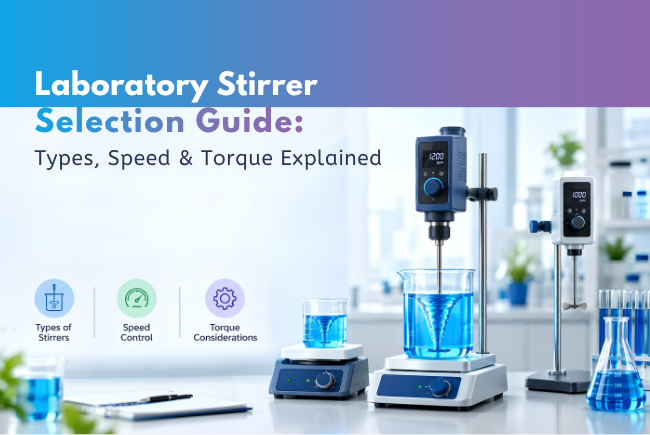
Imagine spending hours precisely formulating a chemical compound, only to have the entire batch ruined due to uneven mixing, localised hot spots or phase separation. In pharmaceutical formulation, chemical synthesis and industrial quality control, mixing is far more than just swirling liquids in a vessel. It is a fundamental unit operation that directly dictates reaction rates, product yield and batch consistency. Selecting the right laboratory stirrer means matching your fluid’s physical properties with the right dynamic power, speed control and vessel design.
Common Laboratory Stirrer Types: Finding the Right Fit
Selecting from various laboratory stirrer types depends on your sample volume, fluid viscosity, working temperature and required process duration. Different designs serve distinct mixing functions across research and production environments.
- Magnetic Stirrers: Utilise a rotating magnetic field to spin a Teflon- or glass-coated stir bar submerged in the liquid. They are ideal for low-viscosity liquids, closed vessels and routine solution preparation.
- Overhead Stirrers: Feature a top-mounted motor connected directly to a drive shaft and mixing impeller. Designed for heavy-duty applications, overhead systems handle high volumes, thick slurries and viscous gels that stop magnetic stirrers cold. An industrial overhead stirrer of this type is the standard choice for pilot-to-production scale-up.
- Hotplate Magnetic Stirrers: Combine magnetic agitation with a heated top plate, allowing simultaneous thermal regulation and liquid homogenisation in a single compact footprint.
- Multi-Position Stirrers: Incorporate multiple magnetic stirring points driven by a single control unit, enabling high-throughput parallel testing across multiple beakers or flasks.
Overhead Stirrer vs Magnetic Stirrer: Which Should You Choose?
When comparing an overhead stirrer vs magnetic stirrer, the choice usually comes down to two main factors: fluid viscosity and working volume.
| Parameter | Magnetic Stirrer | Overhead Stirrer |
| Sample Volume | Microlitres up to 20 L | 1 L up to 200 L+ |
| Viscosity Limit | Low, up to 1,500 mPa·s | Low to high, up to 2,000,000 mPa·s |
| Speed Range | 100–1,500 RPM | 30–2,000+ RPM |
| Drive Mechanism | Magnetic coupling | Direct mechanical drive shaft |
| Vessel Openings | Sealed, unpierced vessel base | Open top or ground-glass port |
| Best Applications | Buffers and low-viscosity aqueous solutions | Resins, polymers and slurries |
Magnetic stirrers excel in routine, low-viscosity tasks where you prefer a completely sealed container. Overhead stirrers are essential for high-viscosity media, large batch volumes or continuous high-torque operations where a magnetic bar would decouple or stall.
Understanding Stirrer Speed and Torque
Proper operation of laboratory mixing equipment requires balancing two key mechanical properties: stirrer speed and torque.
- Stirrer Speed (RPM): Revolutions Per Minute measures how fast the mixing element turns. High RPM creates intense shear forces, ideal for creating emulsions, dissolving fine powders or dispersing gas in liquid.
- Torque (N·cm): Torque measures the rotational force produced by the motor to overcome fluid resistance. High torque is required to turn an impeller through thick, viscous fluids without losing speed or overheating the motor.
Torque (N·m) = {Power (Watts) x 9.5488} / Speed (RPM)
As fluid viscosity increases, resistance against the mixing blade rises exponentially. If your motor lacks sufficient torque, the speed drops drastically, leading to incomplete mixing or motor failure.
Viscosity vs Torque: A Technical Selection Matrix
| Fluid Category | Viscosity Range (mPa·s) | Typical Fluid Examples | Recommended Equipment | Required Torque Profile |
| Low Viscosity | 1 – 100 | Water, dilute acids, light oils | Magnetic Stirrer | Low (< 10 N·cm) |
| Medium Viscosity | 100 – 10,000 | Motor oil, paints, syrups | Compact Overhead Stirrer | Moderate (20 – 60 N·cm) |
| High Viscosity | 10,000 – 100,000 | Adhesives, liquid polymers | Heavy-Duty Overhead Stirrer | High (100 – 200 N·cm) |
| Extreme Viscosity | > 100,000 | Ointments, heavy resins | Multi-Gear Overhead Mixer | Extreme (> 200 N·cm) |
The Role of Impeller Design in Laboratory Stirrer Selection
An overhead stirrer acts merely as the power source; the actual mixing work is performed by the impeller attached to the drive shaft. Matching the impeller geometry to your liquid behaviour is essential for efficient fluid movement.
- Propeller Impellers: Generate axial flow (top-to-bottom movement). Ideal for low- to medium-viscosity fluids, drawing solids down into suspension.
- Anchor Impellers: Create radial flow sweeping close to vessel walls. Designed for high-viscosity fluids to promote heat transfer and prevent wall buildup.
- Paddle Impellers: Provide gentle, low-shear tangential mixing, preserving delicate biological samples or fragile polymers.
- Turbine Impellers: Produce high shear rates and radial displacement, perfect for dispersing immiscible liquids or emulsifying oils.
Crucial Features: BLDC Motors, Timer Functions and Torque Compensation
Modern industrial and research mixers integrate advanced electronic controls that safeguard experimental accuracy and operational efficiency.
- Brushless DC (BLDC) Motors: Eliminate carbon brush wear, reducing maintenance down to zero while delivering quiet, spark-free performance across wide speed ranges.
- Torque Compensation Technology: Automatically adjusts power delivery as fluid viscosity changes during reaction progress, keeping the set RPM strictly constant.
- Programmable Timers & Digital Interfaces: Allow automated run cycles, timed direction reversals and continuous data logging for process validation and audit trails.
Integrating Stirrers with Industrial Glass Vessels
Achieving a leak-free, chemically inert mixing system requires careful coordination between the mechanical stirrer and the reaction vessel. In corrosive chemical processing and pharmaceutical synthesis, standard metal agitators can leach trace impurities or degrade under aggressive acid exposure.
To eliminate contamination risks, process engineers turn to high-purity borosilicate 3.3 components. Goel Scientific Glass Works Ltd. engineers precision-ground glass stirrer shafts, glass-enclosed impellers and custom reaction vessels built for absolute chemical resistance. Operating with an inert glass stirrer shaft inside a borosilicate 3.3 reactor vessel ensures zero metal leaching, full process visibility and smooth dynamic sealing under deep vacuum or elevated temperatures. This complete glass reactor stirrer assembly can be matched to almost any vessel size or joint configuration.
Safety Protocols: Overload Protection and Flameproof Requirements
Operating high-speed or high-power agitation equipment requires strict adherence to safety protocols:
- Thermal Overload Shutdown: Automatic cut-off sensors prevent motor windings from burning out during unexpected viscosity spikes.
- Soft-Start Controls: Gradual speed acceleration prevents splashing, vessel tipping and liquid surge out of open tops.
- ATEX / Flameproof Enclosures: Required when mixing volatile organic solvents or working in explosive gas atmospheres to eliminate spark risks.
Step-by-Step Checklist: Choosing Your Laboratory Stirrer
Before purchasing a new laboratory stirrer, run through this operational checklist:
- Define Fluid Viscosity: What is the maximum viscosity of the sample during mixing?
- Determine Batch Volume: Are you mixing 50 millilitres in a flask or 50 litres in a pilot reactor?
- Select Drive Mechanism: Does your fluid require a simple magnetic bar or an overhead motor drive shaft?
- Choose Impeller Geometry: Do you need high-shear dispersion, gentle blending, or high-viscosity wall sweeping?
- Verify Vessel Compatibility: Does the stirrer shaft match your vessel lid opening, joint size and depth requirements?
- Review Safety Ratings: Do your reagents require ATEX flameproof ratings or sealed vacuum-tight stir bearings?
Conclusion
Selecting the correct laboratory stirrer balances fluid dynamics, motor mechanics and material compatibility. By evaluating your speed requirements, torque demands and fluid viscosities, you can construct a mixing system that ensures consistent, repeatable results across every batch.
Whether you are building bench-top R&D setups or scaling up pilot plant glass reactors, Goel Scientific Glass Works Ltd. supplies high-purity borosilicate glass stirrers, custom agitator shafts and full glass process assemblies built to withstand demanding chemical environments.
Explore our mixing accessories catalogue or contact our technical team today to design your ideal mixing solution.
FAQs
Choose an overhead stirrer when your sample volume exceeds 20 litres, when fluid viscosity rises above 1,500 mPa·s or when mixing requires heavy-duty impellers to prevent phase separation in thick slurries.
RPM measures speed, but torque measures rotational force. Thick, highly viscous liquids create heavy mechanical resistance against the impeller. Without sufficient torque, the motor will stall or burn out regardless of its maximum RPM capability.
Torque compensation is an electronic control feature that automatically monitors motor resistance. If fluid viscosity changes during a reaction (for example, during polymerisation), the stirrer automatically adjusts power output to maintain your precise set RPM.
Yes, overhead stirrers can operate under vacuum when paired with specialised vacuum-tight stirrer bearings or ground-glass dynamic seals that allow the drive shaft to rotate without leaking ambient air into the vessel.
Yes, impeller shape dictates fluid flow direction and shear force. Propellers generate axial flow for solids suspension, anchor impellers sweep high-viscosity fluids along vessel walls and turbine impellers produce high shear forces for emulsification.
