




- GOEL Scientific
- November 18, 2026
- High Pressure Glass Reactor
- 0 Comments
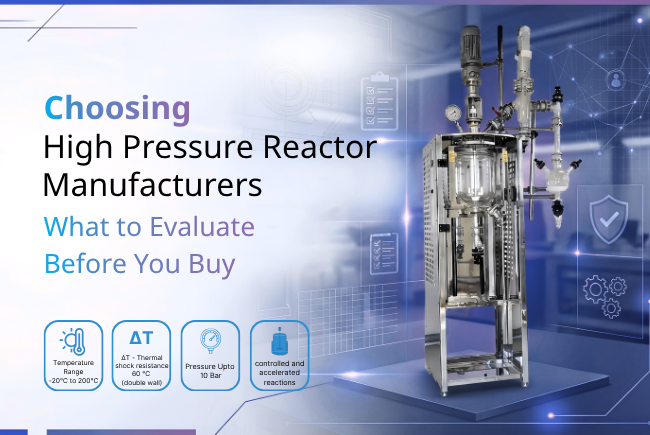
A high-pressure reactor is a long-term investment. The manufacturer selected can affect equipment safety, process reliability, and overall operating costs. Before choosing a supplier, check the pressure ratings, construction materials, instrumentation, and compliance documents. These factors help procurement teams in the pharmaceutical and chemical industries compare manufacturers and make an informed decision.
Why Manufacturer Selection Matters for High Pressure Reactor Performance
High-pressure reactors operate under high thermal and mechanical stress. Their construction requires accurate welding, properly fitted flanges, and a pressure boundary that meets safety requirements. A well-built reactor can provide reliable service over several years. Poor fabrication, on the other hand, can lead to early equipment failure. Documented fabrication standards also help assess a manufacturer’s engineering and quality practices.
Start With Pressure, Temperature, and Process Requirements
Before comparing manufacturers, prepare a process data sheet with the required operating conditions. This helps define the reactor specifications and allows suppliers to provide comparable quotations.
- Design Pressure: Maximum operating pressure, along with an appropriate safety margin.
- Design Temperature: Full operating temperature range, including thermal upset limits.
- Working Volume: Required batch size, with enough headspace for gas-liquid agitation.
- Process Chemistry: Compatibility of all wetted vessel surfaces with the process fluids.
- Pressure Cycle Count: Expected number of operating cycles during the reactor’s service life.
These parameters help define the reactor’s design requirements before procurement. Sharing accurate process details also helps manufacturers recommend suitable equipment.
Check the Reactor Material Before Comparing Manufacturers
Material of construction dictates chemical resistance and maximum working pressure. Matching wetted alloys to process media is critical for operational safety.
- Stainless Steel 316L: General-purpose alloy suitable for organic solutions and dilute acids.
- Hastelloy C-276: Engineered for concentrated acids, halogens, and aggressive chlorides.
- Titanium Grade 2: Preferred choice for wet chlorine and marine environments.
- Borosilicate 3.3 Glass: High-purity, chemically inert glass providing full visual monitoring.
The right material helps the reactor withstand process conditions and reduces the risk of material damage. Compare the available options based on chemical compatibility and the required operating pressure.
How Reactor Design and Customisation Affect Your Process
Standard units handle routine reactions, but specialized processes demand custom engineering. Manufacturers with in-house design capabilities adapt nozzle layouts, vessel aspect ratios, and jacket geometry. Modifying agitator design ensures reliable mixing dynamics during pilot scale-up.
Which Safety Features Should a High Pressure Reactor Include?
Pressure vessels require integrated protective systems. Leading manufacturers incorporate multiple safety redundancies directly into the design.
- Pressure relief valve calibrated to certified ASME standards.
- Rupture disk acting as a secondary pressure release backup.
- Independent over-temperature cut-off controller.
- Safety-interlocked drain and vent valves.
- Calibrated pressure gauge positioned for direct visual monitoring.
- Hydrostatic test certificate for every pressure boundary.
Look Beyond the Vessel: Agitation, Valves, and Instrumentation
An industrial supplier delivers complete process assemblies rather than plain bare vessels. Evaluating auxiliary subsystems avoids costly retrofits after installation.
- Agitator drive sized to handle maximum fluid viscosity.
- Magnetic coupling seal rated for working pressure and media.
- Zero-dead-volume bottom discharge valve.
- Thermowell temperature probe matched to vessel alloy.
- Pressure transmitter with an isolation diaphragm.
What Quality Standards Should Your Reactor Manufacturer Meet?
Compliance certification verifies structural integrity and manufacturing quality.
- ASME Section VIII Division 1 for pressure boundary design.
- PED 2014/68/EU certification for European markets.
- ISO 9001 certification for quality management.
- ATEX Directive 2014/34/EU compliance for explosive atmospheres.
- cGMP documentation package for pharmaceutical compliance.
How to Assess an Industrial Reactor Supplier Before Ordering
A systematic vendor evaluation process protects your investment and ensures timely delivery.
- Request material test reports (MTR) for pressure-boundary metals.
- Verify welder qualifications and non-destructive testing records.
- Inspect the manufacturing facility or request a virtual workshop audit.
- Review client references from similar chemical applications.
- Confirm official ASME or PED authorization numbers.
- Verify local technical support and spare-parts availability.
Custom Reactor Manufacturing: When Standard Designs Are Not Enough
Custom manufacturing becomes essential when process requirements exceed standard catalogue limits. Handling slurries, high temperatures, or specialized reactions requires custom vessel configurations. Experienced builders utilize 3D CAD modeling to validate custom designs prior to fabrication.
High Pressure Reactor Procurement Checklist for B2B Buyers
Use this checklist to compare technical proposals across candidate manufacturers.
| Evaluation Area | Minimum Requirement |
| Design Code | ASME VIII Div 1 or PED |
| Material Certification | EN 10204 Type 3.1 or 3.2 |
| Weld Inspection | Radiographic or ultrasonic inspection on main seams |
| Hydrostatic Test | Certified test per applicable design code |
| Dimensional Check | Signed dimensional inspection report |
| After-Sales Support | Stocked spare parts and written response SLA |
Conclusion
Selecting a reactor manufacturer requires technical evaluation beyond purchase price. A qualified supplier delivers documented quality, precise engineering, and long-term operating safety.
Goel Scientific Glass Works Ltd. manufactures certified Borosilicate 3.3 glass process equipment for chemical industries worldwide. Its High Pressure Glass Reactor operates at working pressures up to 10 bar. Built with certified relief valves, overpressure protection, and emergency shutdown features, these systems deliver safe, reliable performance.
Equip your facility with a certified High Pressure Glass Reactor engineered for maximum process safety. Contact the technical experts at Goel Scientific Glass Works Ltd. today to discuss your custom pressure specifications.
Frequently Asked Questions
Review pressure-boundary welds, material traceability, and ASME Section VIII certifications. Confirm after-sales support and request customer references. Manufacturers providing hydrostatic test certificates and welder qualifications consistently deliver reliable equipment
ASME Section VIII Division 1 sets the baseline for pressure vessel design. PED 2014/68/EU applies within Europe, while ISO 9001 covers quality management. ATEX standards cover explosive environments, and cGMP applies to pharmaceutical facilities.
Custom fabrication is required when operating conditions exceed standard catalogue specifications. Typical requirements include extreme temperatures, solids handling, special nozzle layouts, or scale-up designs that must match exact laboratory vessel geometry.
Provide working pressure, operating temperature, batch volume, process chemistry, pressure cycles, and footprint dimensions. Include desired Agitator designs, instrumentation ports, and utility connections to receive accurate, comparable quotes.
Your checklist should evaluate design codes, material certifications, weld inspection methods, hydrostatic test records, and after-sales service terms. Require complete documentation, including material test reports, welder qualifications, and pressure certificates.
