




- GOEL Scientific
- November 6, 2026
- Jacketed Vessel
- 0 Comments
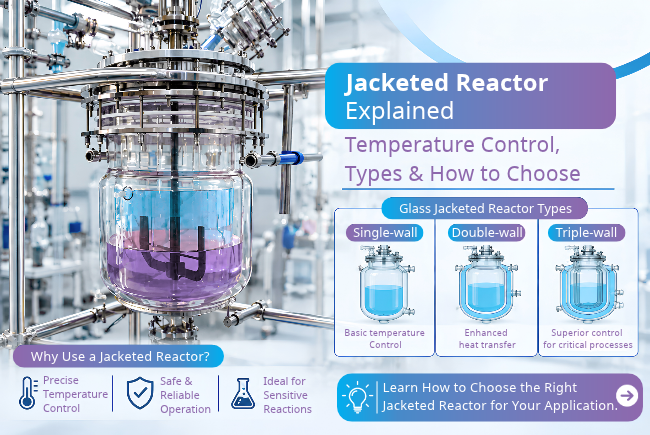
A Jacketed Reactor is a reaction vessel surrounded by an external jacket for circulating thermal fluid. The vessel is constructed from certified Borosilicate 3.3 glass. The jacket can be glass or metal depending on the process design. This article covers heat transfer, jacket types, and key selection parameters for choosing the right Jacketed Reactor unit.
Why Temperature Management Matters in Reactor Operations
Precise thermal control remains critical across pharmaceutical synthesis and specialty chemical processes. Reactor temperature control methods shape how operators run sensitive reactions. A Jacketed Reactor supports controlled heating and cooling of active reaction mixtures. It enables precise regulation during exothermic or endothermic reactions. The system also supports gradual temperature ramping and programmed thermal profiles.
Understanding the Heat-Transfer Process Inside a Jacketed Reactor
Heat transfer in a Jacketed Reactor occurs directly through the inner vessel wall. As thermal fluid flows through the jacket, it exchanges heat with the process mass. Sensors in the reaction mass and jacket connections feed data back to a controller. The controller adjusts fluid temperature and flow rate to maintain your exact setpoint. Circulating different thermal fluids lets one jacket handle both heating and cooling cycles.
Heating and Cooling Options for Different Process Requirements
Jacket media selection depends on whether your process requires heating or cooling. Common media for Reactor heating and cooling include:
- Steam: Used for high-temperature heating duties.
- Hot Water: Applied for moderate heating operations.
- Cold Water: Utilised for standard cooling duties.
- Thermal Oil: Circulated as a high-temperature heat-transfer fluid.
- Refrigerants: Employed for low-temperature cooling duties.
An external Temperature Control Unit conditions the heat-transfer fluid efficiently. It circulates the medium through the jacket at the required flow rate.
Jacket Configurations: Single, Double and Other Designs Compared
Choosing the right Jacketed Reactor configuration depends on working temperature, pressure, and scale. A Double-Jacket Reactor serves as the standard choice for synthesis, extraction, and crystallisation.
| Design | Construction | Best Use |
| Single-Wall Reactor | Single Borosilicate 3.3 glass wall | Basic applications where external temperature control is sufficient |
| Double-Jacket Reactor | Inner vessel with outer jacket for thermal fluid | Chemical synthesis, extraction, and crystallisation processes |
| Triple-Walled Reactor | Vacuum-Jacketed layer for added thermal insulation | Cryogenic applications needing low-temperature stability |
| Glass Reactor with Metal Jacket | Borosilicate 3.3 glass vessel with SS316 metal jacket | Tight temperature control and cryogenic reactions down to –50 °C |
Key Factors That Influence Jacketed Reactor Heat Transfer
Thermal efficiency inside a Jacketed Reactor depends heavily on jacket geometry and agitation. Key engineering design factors include:
- Jacket Type: Single-Wall, Double-Jacket, segmented, or spiral designs in glass or metal.
- Jacket Layout: Segmented, baffled, or zoned layouts improve thermal uniformity and prevent local hotspots.
- Agitator Design: Stirrer blades sized correctly for process fluid viscosity and batch volume.
In a Double-Jacket Reactor, these design choices maintain uniform temperature across the reaction mass.
Common Jacketed Vessel Applications Across Industries
Process industries rely on the visual clarity and precise control a Jacketed Reactor provides. Primary industrial deployments include:
- Pharmaceutical API synthesis under strict process conditions.
- Fine chemical manufacturing requiring tight temperature boundaries.
- Polymer development and polymerisation studies.
- Controlled crystallisation and precipitation evaluation.
- Natural product extraction using volatile organic solvents.
- Pilot-scale process development for thermally sensitive chemistries.
These applications extend across R&D suites in pharmaceutical and chemical testing laboratories.
Processes Where Controlled Heating and Cooling Are Essential
Many chemical process runs depend on rapid thermal regulation as a core requirement. Key temperature-critical operations include:
- Exothermic or endothermic reactions needing continuous thermal regulation.
- Gradual temperature ramping or programmed linear thermal profiles.
- Crystallisation processes highly sensitive to internal thermal gradients.
- Cryogenic reactions and processing under high vacuum conditions.
Important Factors to Evaluate When Selecting a Jacketed Reactor
Selecting the right jacketed reactor requires a careful review of your process data sheet. Important evaluation points include:
- Working volume requirements of the vessel.
- Operating temperature range specified by your process chemistry.
- Pressure rating for process pressure or full vacuum service.
- Vessel material choice between Borosilicate 3.3 glass or specialty metals.
- Jacket material and structural configuration matched to thermal requirements.
- Agitator drive and impeller profile sized to fluid viscosity.
Capacity, Materials, Temperature and Pressure: Key Selection Parameters
Engineers narrow vessel selection down to four core parameters.
- Capacity: 5 L to 500 L for glass Jacketed Reactor vessels; 5 L to 200 L for Glass Reactor with Metal Jacket units.
- Materials: Borosilicate 3.3 glass vessel, PTFE seals, and SS316 metal support framework.
- Temperature: –50 °C to +200 °C operating range for Glass Reactor with Metal Jacket units.
- Pressure: Pressure rating up to 1 bar with full vacuum support.
Agitation, Utilities and Instrumentation: Other Selection Considerations
A comprehensive Jacketed Reactor specification covers utilities and ancillary components. Key auxiliary elements include:
- Top glass cover with nozzles for Agitator, Condenser, feed lines, and sensors.
- Jacket inlet and outlet connections engineered for high thermal fluid flow.
- Temperature sensors and digital monitoring instruments.
- Gas purging, vacuum ports, exhaust lines, and auxiliary feed receivers.
- Zero-dead-leg bottom discharge valve in PTFE or glass-lined material for clean drainage.
Conclusion
Matching vessel capacity, materials, temperature limits, pressure ratings, and jacket geometry ensures safe and reliable chemical processing. Combining high-purity Borosilicate 3.3 glass with engineered jacket designs protects sensitive chemistries while delivering total process visibility. Investing in high-quality Jacketed Reactor systems guarantees repeatable synthetic yields and reliable thermal management across laboratory and pilot operations.
Equip your processing suite with a reliable Jacketed Reactor engineered for precise temperature control. Contact the technical experts at Goel Scientific Glass Works Ltd. today to specify the ideal reactor for your facility.
Frequently Asked Questions
A Jacketed Reactor performs chemical reactions requiring precise temperature regulation. Common applications include active pharmaceutical ingredient (API) synthesis, fine chemical processing, controlled crystallisation studies, and low-temperature cryogenic reactions across research and pilot facilities.
An external Temperature Control Unit, also known as a chiller-heater, conditions thermal heat-transfer fluid. The unit circulates fluid through the outer jacket, while integrated sensors monitor fluid temperatures to hold setpoints accurately.
A Single-Wall Reactor suits basic mixing tasks. A Double-Jacket Reactor provides an outer fluid jacket for standard heating and cooling. A Triple-Walled Reactor adds an outer vacuum layer for thermal insulation during cryogenic processing.
Engineers select jacket media based on thermal requirements. Standard media choices include industrial steam, hot water, cold water, circulating thermal oils, and specialised liquid refrigerants managed by an external temperature control loop.
Selecting a Jacketed Reactor requires evaluating working batch volume, operating temperature range, working pressure ratings, vessel and jacket materials, Agitator drive sizing, thermal fluid utilities, and required instrument nozzle ports.
