




- GOEL Scientific
- November 23, 2026
- High Pressure Glass Reactor, Solvent Recovery System
- 0 Comments
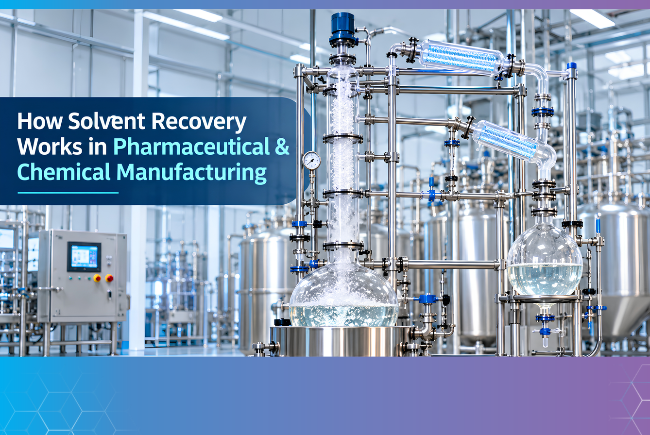
Solvent recovery turns spent process solvents into clean liquid for reuse. Plants collect used solvent, remove contaminants and return the purified product to production. Distillation is a common method in chemical and pharmaceutical plants. Pharmaceutical solvent recovery must also meet defined quality requirements before recovered solvent returns to a drug process. Well-designed equipment can lower purchase costs, waste volumes and emissions. Each plant needs a method that suits its solvents and impurities.
What Is Solvent Recovery? Role of a Solvent Recycling System
Recovery reclaims solvents such as ethanol, acetone and toluene after reaction, extraction or cleaning. Clean solvent then returns to the process. A Solvent Recycling System connects collection tanks, purification equipment and storage units. It helps close the solvent loop within the plant.
Why Pharma and Chemical Plants Invest in Solvent Recovery
Plants invest for several measurable reasons:
- Lower Purchase Costs: Reused solvent reduces fresh solvent buying.
- Reduced Disposal: Less waste leaves the site for incineration.
- Lower Emissions: Closed recovery cuts volatile organic compound release.
- Supply Security: Plants depend less on market price swings.
- Sustainability Targets: Recovery supports company waste and carbon reduction goals.
These benefits can strengthen the business case for installing a solvent recovery system. Actual savings depend on the solvent, recovery efficiency and operating costs.
Solvent Recovery Process: 6 Steps from Spent Solvent to Reusable Solvent
A typical Solvent Recovery Process follows six steps:
- Collection: Segregate spent solvent by type in labelled tanks.
- Pre-treatment: Filter solids and separate water or oil layers.
- Distillation: Heat the feed in a solvent distillation unit to vaporise the solvent.
- Condensation: Cool the vapour in condensers to form clean liquid.
- Polishing: Remove trace water with molecular sieves or a second column.
- Testing and Storage: Check purity, then store the solvent for reuse.
The remaining residue requires safe handling and disposal through approved facilities. The exact process steps depend on the feed composition and required solvent purity.
Solvent Recovery Methods Compared: Which Technique Fits Your Solvent?
Each method suits a different solvent and impurity profile:
| Method | Best Suited To |
| Simple distillation | Solvents with non-volatile residues |
| Fractional distillation | Close-boiling solvent mixtures |
| Vacuum distillation | Heat-sensitive or high-boiling solvents |
| Thin-film evaporation | Viscous or high-solids feeds |
| Pervaporation or membranes | Dehydrating azeotropic mixtures |
| Adsorption | Solvent vapour in exhaust air |
Laboratory trials confirm the right method before scale-up. Feed composition data guides this choice.
Solvent Recovery System and Unit Components, Including Glass Solvent Recovery Systems
A typical distillation-based Solvent Recovery System includes five core components:
| Component | Function |
| Reboiler | Heats and vaporises the feed |
| Column | Separates solvent from impurities |
| Condensers | Turn vapour back into liquid |
| Reflux divider | Returns part of the condensate to the column |
| Receiver | Collects the recovered solvent |
A Glass Solvent Recovery System adds visibility and can offer corrosion resistance for compatible process media. Borosilicate Industrial Glass Process Equipment is used in selected applications involving acidic and chlorinated solvent streams. Material compatibility must be checked against the actual solvent composition and operating conditions.
Glass Fractional Distillation Unit: Separating Close-Boiling Solvents
A Glass Fractional Distillation Unit places a packed or plate column above the reboiler. Repeated vaporisation and condensation along the column separate solvents with close boiling points.
Reflux control sets the purity of the top product. Higher reflux ratios give purer distillate but slower throughput. Goel Scientific Glass Works Ltd. offers continuous distillation systems for laboratory, pilot and small production-scale applications. Confirm the system configuration and capacity for the intended process.
Pharmaceutical Solvent Recovery: GMP, ICH Q3C and Quality Control
Recovered solvent in drug manufacture must meet defined standards:
- ICH Q7 Reuse Rules: Section 14.4 permits reuse when recovery stays controlled and solvents meet specifications.
- ICH Q3C Limits: Residual solvent limits follow Class 1, 2 and 3 toxicity groups.
- Quality Testing: Gas chromatography and water content tests confirm purity.
- Dedicated Use: Many plants reuse recovered solvent in the same process to limit cross-contamination.
- Batch Records: Each recovered lot needs traceable documentation.
Validated procedures protect patient safety and audit readiness.
Chemical Solvent Recovery: Common Solvents, Azeotropes and Challenges
Chemical Solvent Recovery often handles azeotropes that resist simple separation:
| Solvent Pair | Azeotrope | Recovery Approach |
| Ethanol-water | About 95.6% ethanol by weight | Molecular sieves or pervaporation |
| Isopropanol-water | About 88% isopropanol by weight | Pervaporation or extractive distillation |
| THF-water | About 95% THF by weight | Pressure-swing distillation |
| Acetonitrile-water | About 84% acetonitrile by weight | Pressure-swing distillation |
| Ethyl acetate-water | Two-phase azeotrope | Decanting and redistillation |
These figures and recovery approaches should be verified for the relevant operating conditions.
How to Choose a Solvent Recovery System and Calculate Payback
Match the solvent recovery unit to these factors:
| Factor | What to Assess |
| Capacity | Daily spent solvent volume |
| Purity | Required reuse specification |
| Solvent mix | Boiling points and azeotropes |
| Materials | Corrosive or chlorinated components |
| Operation | Batch or continuous duty |
| Utilities | Steam, cooling water and vacuum supply |
Payback period (years) = Capital cost ÷ Annual net savings
Annual net savings = Solvent purchase savings + Disposal savings − Operating costs
Use real plant figures for each term, including labour and maintenance.
Why Choose Goel Scientific for Glass Solvent Recovery and Distillation Units
Goel Scientific Glass Works Ltd. designs glass-based systems for process loads ranging from a few kilograms to several tonnes per day, subject to system configuration. Each system may combine a continuous column, reboiler, reflux control, primary and secondary condensers, and a receiver.
Its borosilicate construction supports solvent recovery applications involving compatible process media. Goel Scientific Glass Works Ltd. also offers simple distillation units, vacuum distillation systems and Wiping Film Evaporators for selected process requirements.
Share your requirements with our engineers for a tailored recommendation.
Frequently Asked Questions (FAQs)
It is the collection and purification of used process solvents for reuse. Recovered solvent must meet set specifications before it returns to production.
Plants collect spent solvent, remove solids and water, then distil it. Condensers return clean liquid, which passes quality tests before reuse.
A Glass Solvent Recovery System is used to recover compatible solvents in borosilicate glass equipment. Its transparent construction allows process visibility. Such systems can be considered for laboratory, pilot-scale and selected production applications.
A simple unit boils the feed once and suits solvents with non-volatile residues. A fractional unit adds a packed or plate column with reflux to separate close-boiling solvents.
Yes. Distillation reaches about 95.6% ethanol, and molecular sieves or pervaporation remove the remaining water. ICH Q7 allows reuse when the plant controls recovery, and the solvent meets specifications.
Assess the daily volume of spent solvent, required recovery rate and target purity. Also consider batch or continuous operation, future production requirements and available utilities. These details help determine the capacity and configuration of the recovery unit.
