




- GOEL Scientific
- November 16, 2026
- Glass Reactor
- 0 Comments
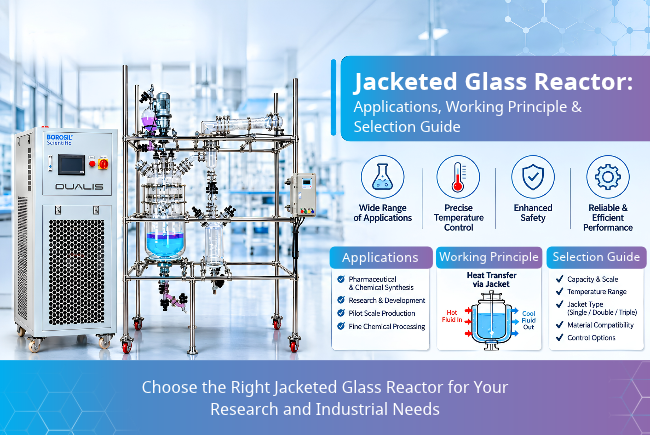
A Jacketed Glass Reactor is a transparent reaction vessel with an outer jacket for circulating thermal fluid. Jacketed Glass Reactor applications span synthesis, crystallisation, and distillation across chemical research. This guide covers the working principle, heating and cooling methods, jacket types, and selection parameters.
Why Use a Jacketed Glass Reactor for Controlled Laboratory Processes?
Chemical inertness and visual monitoring make a Jacketed Glass Reactor essential in research laboratories. Borosilicate 3.3 glass resists acids, halogens, and most organic reagents. Transparent walls let operators observe colour changes, crystal growth, and phase behaviour directly. Common laboratory glass reactor uses include process development, scale-up studies, and small-batch production.
Understanding the Glass Reactor Working Principle
The glass reactor working principle relies on sealed containment, efficient agitation, and steady heat transfer. The inner vessel holds the reaction mixture securely. The outer jacket carries heat-transfer fluid at a regulated setpoint. The agitator shaft enters through a sealed port to transmit drive motion.
Heat flows between the jacket fluid and reaction mass across the borosilicate wall. Temperature sensors feed back to an external Temperature Control Unit. The sealed envelope supports full vacuum operation or modest positive pressure.
How the Reactor Heating and Cooling System Controls Temperature
A reactor heating and cooling system uses an external Temperature Control Unit to condition jacket fluid. The unit conditions fluid to setpoints and pumps it through the jacket.
- Operating Range: Configured as per vessel design and thermal unit capacity.
- Heat-Transfer Fluid: Thermal oil for high temperatures; glycol-water for low temperatures.
- Flow Rate: Matched to reactor volume and the process thermal duty.
- Control Accuracy: Managed precisely by the digital PID loop.
A correctly sized Reactor heating and cooling system removes exothermic heat safely.
Single, Double and Other Jacket Configurations for Glass Reactors
Selecting the right jacket configuration depends on your process temperature window.
| Configuration | Typical Use |
| Single-Wall Reactor | Basic applications where external temperature control is sufficient |
| Double-Wall Reactor | Chemical synthesis and controlled crystallisation |
| Triple-Wall Reactor | Low-temperature cryogenic reactions requiring vacuum insulation |
| Glass Reactor with Metal Jacket | Enhanced thermal control with full visibility of the glass vessel |
Jacketed Glass Reactor Applications Across Laboratory and Industrial R&D
A Jacketed Glass Reactor handles diverse unit operations across chemical and pharmaceutical research. Primary industrial uses include:
- Synthesis of active pharmaceutical ingredients (API).
- Controlled crystallisation with programmed cooling profiles.
- Liquid-liquid extraction with multi-phase mixing.
- Catalytic reactions conducted under inert atmosphere.
- Polymer synthesis demanding precise viscosity and thermal control.
- Distillation and solvent removal via top-mounted condensers.
These laboratory glass reactor uses scale to pilot units of similar geometry.
Which Laboratory Processes Are Suitable for Glass Reactors?
Understanding equipment limits ensures safe processing across laboratory applications. Choose glass vessels for:
- Reactions running within standard positive pressure ratings.
- Chemistry involving strong acids, halogens, or organic solvents.
- Processes requiring direct visual endpoint recognition.
- API synthesis steps where metal contamination must be avoided.
For higher working pressures, use a heavy-wall High Pressure Glass Reactor.
What Glass and Construction Features Affect Reactor Performance?
Equipment performance depends directly on glass grade and dimensional fabrication standards. A thorough selection guide evaluates:
- Borosilicate 3.3 glass conforming to ISO 3585 and ASTM E438.
- Uniform wall thickness free of mechanical stress points.
- Precision ground taper joints or industrial flanged couplings.
- PTFE sealing surfaces free of surface damage.
- Smooth internal finishes for zero-dead-leg drainage.
Glass Reactor Selection Guide: Parameters to Evaluate Before Buying
Evaluating key parameters on your process data sheet ensures accurate equipment selection. Review these essential variables:
- Working batch volume with headspace allowance for agitation.
- Operating temperature range across the process cycle.
- Pressure rating for vacuum and positive-pressure service.
- Agitator design matched to process fluid viscosity.
- Nozzle layout for feed lines, condensers, and sensors.
How Capacity, Temperature, Pressure and Agitation Influence Selection
Four core parameters drive vessel selection and auxiliary system design.
- Capacity: Match required batch volume with proper headspace.
- Temperature: Wider thermal ranges require vacuum jackets and larger thermal units.
- Pressure: Higher ratings expand total reaction scope.
- Agitation: Viscous fluids require high-torque drive motors.
A complete selection guide covers these factors together.
Glass Reactor Selection Checklist for Laboratory and R&D Teams
Use this checklist to evaluate quotes from candidate glass equipment suppliers.
| Parameter | Specification Required |
| Volume | Working volume and nominal total volume |
| Temperature Range | Minimum and maximum limits with thermal cycling |
| Pressure Rating | Full vacuum level and positive pressure limits |
| Agitator | Impeller type, speed range, and motor torque |
| Documentation | Material certificates and pressure test records |
Conclusion
A thorough selection guide turns complex technical requirements into a clear buying decision. Matching vessel volume, thermal ranges, working pressure, and agitation ensures reliable synthetic performance.
Goel Scientific Glass Works Ltd., a Borosil Scientific company founded in 1977 at Vadodara, builds glass reactors in spherical (5 L to 500 L) and cylindrical (5 L to 800 L) designs. Available with glass or metal jackets, these units serve global pharmaceutical and chemical industries. Our engineering team also fabricates custom vessels matched to client drawings.
Upgrade your laboratory setup with a high-performance Jacketed Glass Reactor built for accurate thermal control. Contact the technical experts at Goel Scientific Glass Works Ltd. today to discuss your custom vessel design.
Frequently Asked Questions
A Jacketed Glass Reactor handles controlled chemical reactions across pharmaceutical and chemical laboratories. Common Jacketed Glass Reactor applications include API synthesis, crystallisation, liquid extraction, catalytic reactions, and polymer development.
The glass reactor working principle combines a sealed Borosilicate 3.3 glass reaction chamber with an outer fluid jacket. An external Temperature Control Unit regulates jacket fluid, while an agitator mixes the process mass.
A Reactor heating and cooling system uses a Temperature Control Unit that conditions thermal fluid to setpoints. Integrated temperature sensors feed data to a PID controller, continuously adjusting fluid temperature.
Common laboratory glass reactor uses include synthesis of pharmaceutical intermediates, controlled crystallisation, liquid-liquid extraction, catalytic reactions under inert gas, and formulation development across pilot facilities.
A thorough selection guide evaluates working batch volume, operating temperature limits, pressure ratings, Agitator motor sizing, and top cover nozzle layouts. Every parameter must match your actual process data sheet.
