




- GOEL Scientific
- September 4, 2026
- Borosilicate Glass
- 0 Comments
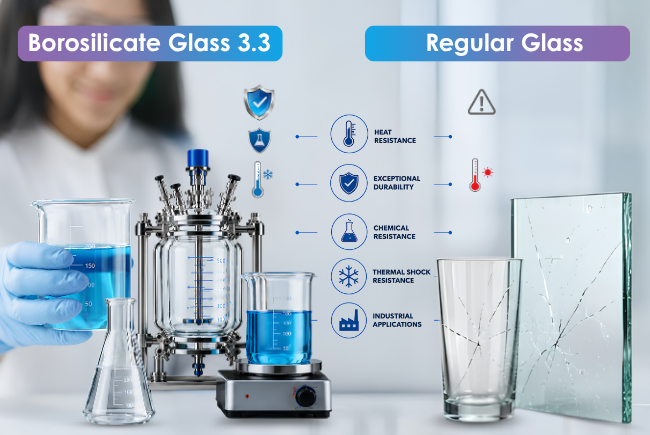
At 250°C, a sudden shift in process temperature will instantly shatter standard soda-lime glass, yet high-purity Borosilicate Glass 3.3 remains entirely unaffected. In modern chemical manufacturing and pharmaceutical synthesis, where a fraction of a degree or a single micro-fissure can compromise an entire multi-million-rupee batch, the choice of vessel material is critical. While regular glass meets basic lab needs, Borosilicate 3.3 has redefined industrial process design through its extraordinary molecular integrity, extreme thermal tolerance and absolute chemical inertness.
What is Borosilicate Glass 3.3?
Borosilicate glass 3.3 is a specific composition of silica, boron trioxide, sodium oxide and aluminium oxide standardised under DIN ISO 3585 and ASTM E438 Type I Class A. The number 3.3 refers to the coefficient of linear thermal expansion, approximately 3.3 x 10⁻⁶ / K, which is far below the roughly 9 x 10⁻⁶ / K of ordinary soda-lime glass.
The fundamental difference is the source of the core properties of borosilicate glass 3.3, making it suitable for demanding industrial applications. Low expansion means minimal thermal shock stress, high chemical resistance ensures zero ion leaching and a tight compositional standard guarantees predictable performance across complex pilot and industrial plant installations.
Top Borosilicate Glass 3.3 Properties and Industrial Advantages
The properties of Borosilicate 3.3 drive its widespread adoption across mechanical, thermal, chemical and optical applications:
- Low Thermal Expansion Coefficient: Operates smoothly across extreme temperature swings without structural distortion.
- Exceptional Thermal Shock Resistance: Withstands rapid quenching from over 250°C without cracking or micro-fracturing.
- Superior Chemical Resistance: Unaffected by concentrated acids, halogens and aggressive organic solvents.
- Hydrolytic Stability: Meets USP Type I standards for pharmaceutical use, releasing negligible alkali into contact media.
- Optical Transparency: Clear, colourless material giving complete, unhindered visibility of critical process reactions.
- Dimensional Stability: Holds ground joints, flanges and structural fittings within tight tolerances over decades.
- High Softening Temperature: Softens around 820°C, safely above process operating conditions.
- International Compliance: Fully certified to DIN ISO 3585, ASTM E438 and USP <660> standards.
Borosilicate Glass vs Regular Glass: A Technical Comparison
Comparing Borosilicate Glass 3.3 with regular soda-lime glass highlights why standard glassware is unfit for demanding chemical processing environments. Soda-lime glass, commonly used in windows, bottles and non-critical laboratoryware, is inexpensive but fails rapidly under industrial thermal and chemical stresses.
| Property | Borosilicate Glass 3.3 | Regular (Soda-Lime) Glass |
| Thermal expansion | 3.3 x 10⁻⁶ /K | ~9 x 10⁻⁶ /K |
| Thermal shock | Excellent (>250°C) | Poor (<50°C) |
| Chemical resistance | Excellent (Acid/Solvent resistant) | Poor (Prone to etching and leaching) |
| Silica content | ~81% | ~72% |
| Boron trioxide | ~13% | None |
| USP Type | Type I | Type III / NP |
| Use | Pharma, Chemical Process Equipment, APIs | Bottles, Windows, Basic Containers |
Why Borosilicate Glass 3.3 is Important for the Pharmaceutical Industry
Using Borosilicate Glass 3.3 in the pharmaceutical industry is not merely a preference. It is a strict regulatory standard. USP <660> and Ph. Eur. 3.2.1 mandate Type I glass for primary packaging and contact surfaces involving parenteral and injectable products due to its high hydrolytic resistance. It releases virtually zero alkali into aqueous solutions, keeping the pH of sensitive drugs stable throughout their shelf life.
Beyond packaging, engineering full-scale process systems in borosilicate glass, such as those custom-fabricated by Goel Scientific Glass Works Ltd., has become the global benchmark for API synthesis and purification. Contact with vessel walls during Active Pharmaceutical Ingredient (API) production carries severe contamination risks. Utilising inert, non-leaching Borosilicate 3.3 vessels and assemblies eliminates heavy-metal impurity risks, simplifies ICH Q3D compliance and protects high-value batches.
Applications of Borosilicate Glass in the Chemical Industry
The applications of borosilicate glass in the chemical industry span nearly every unit operation involving aggressive or high-purity fluids:
- Reaction Units: Handling harsh synthesis without vessel corrosion.
- Distillation & Evaporation Columns: Allowing precise separation and visual monitoring of boiling zones.
- Heat Exchangers: Managing severe thermal duties without thermal shock failures.
- Absorption & Scrubbing Towers: Safely neutralising toxic and corrosive off-gases.
- Storage & Receiver Vessels: Storing high-purity intermediates without leaching.
To meet the intricate demands of scale-up facilities and speciality chemical synthesis, manufacturers like Goel Scientific Glass Works Ltd. engineer custom borosilicate glass assemblies, including Rotary Evaporators, Temperature Control Units and complex Industrial Technical Packages, tailored precisely to unique plant layouts and process chemistries.
Durability & ROI: Why Industrial Plants Invest in Borosilicate 3.3
Durability is the primary driver of return on investment (ROI) for Borosilicate 3.3 installations. While lined steel or metallic alloys in corrosive service frequently require expensive re-lining, passivation or total replacement every few years, a well-engineered borosilicate glass system operates reliably for two decades or longer.
By eliminating downtime, preventing contamination-related batch losses and avoiding frequent equipment replacements, Borosilicate 3.3 delivers a significantly lower total cost of ownership (TCO), making it the most cost-effective capital investment for modern process plants.
Conclusion
Borosilicate Glass 3.3 remains the gold standard for pharmaceutical and chemical processing due to its unrivalled thermal shock tolerance, hydrolytic stability and absolute chemical inertness. Unlike standard soda-lime glass or corrosive-prone metals, it protects high-value API batches, ensures strict regulatory compliance and provides full process visibility. Investing in precision-engineered borosilicate glass equipment drastically lowers total cost of ownership while maximising operational safety. For facilities handling aggressive chemistry, high temperatures or strict purity mandates, Borosilicate 3.3 is an indispensable asset for long-term industrial reliability.
Looking to scale up your synthesis, replace corrosive metallic vessels or build a custom industrial glass assembly? Goel Scientific Glass Works Ltd. brings decades of engineering excellence as a premier manufacturer of high-purity Borosilicate Glass 3.3 equipment. From custom reaction units and heat exchangers to complete turnkey glass process plants, our technical team builds tailor-made solutions compliant with international GMP standards.
Contact Goel Scientific Glass Works Ltd. today to request a technical consultation or custom quote for your plant.
FAQs
Borosilicate 3.3 has a much lower thermal expansion coefficient of 3.3 x 10⁻⁶ / K, giving it exceptional thermal shock resistance and a specialised chemical composition containing ~13% boron trioxide. Regular soda-lime glass cracks under sudden temperature changes and leaches alkali into contact media, rendering it unsuitable for critical chemical and pharmaceutical processing.
Borosilicate 3.3 meets USP Type I standards for hydrolytic resistance, which is mandatory for parenteral product contact and primary packaging. Its chemical inertness prevents heavy-metal contamination and ion leaching, protecting drug purity and facilitating ICH Q3D compliance.
Yes, Borosilicate 3.3 is virtually inert to concentrated sulphuric, nitric and hydrochloric acids at standard operating temperatures. The only major industrial exception is hydrofluoric acid (HF), which attacks silica directly. For almost all other aggressive acid applications, it is the industry reference material.
Yes, although the initial capital investment is higher than standard carbon steel, Borosilicate 3.3 delivers a much lower total cost of ownership over a 20+ year service life. It eliminates expensive vessel re-lining, reduces contamination risks and requires far less maintenance in corrosive environments.
Yes, at Goel Scientific Glass Works Ltd., we specialise in custom glass fabrication, tailoring glass reactors, distillation columns, heat exchangers and specialised packages (such as Peptide Synthesisers and Rotary Evaporators) to fit your exact process parameters, spatial layout and regulatory requirements.
