




- Keyur Patel
- August 7, 2026
- Simple Distillation
- 0 Comments
Simple distillation is a separation technique used to isolate a volatile liquid from a non-volatile residue or to separate two liquids whose boiling points differ by at least 25°C. It involves heating a liquid until it vaporises, then cooling the vapour in a condenser to recover it in pure form. The method is important in laboratories and small-scale industrial operations where reliable solvent recovery and water purification are required. Due to this, it is important to understand how simple distillation works.
What is Simple Distillation in Chemistry?
To answer the question, “What is simple distillation in chemistry?” It refers to a single-stage thermal separation process used to isolate a volatile substance from non-volatile impurities. Since this method does not use a fractionating column, it works better when the components have clearly different boiling points.
The process begins when the mixture is heated in a distillation flask. As the volatile component vaporises, it travels through a condenser, where cooling water condenses the vapour back into liquid form, known as the distillate. Due to its ease of operation, simple distillation is used in chemical laboratories, pharmaceutical facilities, and educational institutions.
When to Use the Simple Distillation Method
The simple distillation method is ideal for basic separation processes where high-purity fractionation is not necessary. It is commonly used to separate water from salt solutions, recover solvents from waste mixtures, and remove low-boiling impurities from chemical solutions. The method is also suitable for laboratory verification of boiling points, pilot-scale solvent recovery, and troubleshooting distillation sequences during process development.
Step-by-Step Process of Simple Distillation
The process of simple distillation follows a simple process:
- The mixture is poured into a distillation flask, and its temperature is measured.
- The flask is heated steadily using a heating mantle, water bath, or oil bath.
- As the temperature reaches the boiling point, the liquid vaporises and rises into the still head.
- The vapour passes through a condenser, where circulating cold water removes heat and converts the vapour back to liquid.
- The condensed, purified liquid flows into a receiving flask.
- The non-volatile residue remains in the distillation flask and is collected separately or disposed of according to its nature.
It is important to control the temperature throughout the process to maintain stable separation.
Components of a Simple Distillation Apparatus
A complete distillation setup includes the following interconnected components:
- Distillation flask
- Condenser
- Receiver
- Thermometer
- Support structure and joints
The quality of these components directly affects safety, vapour containment, and product purity.
Understanding the Glass Simple Distillation Unit
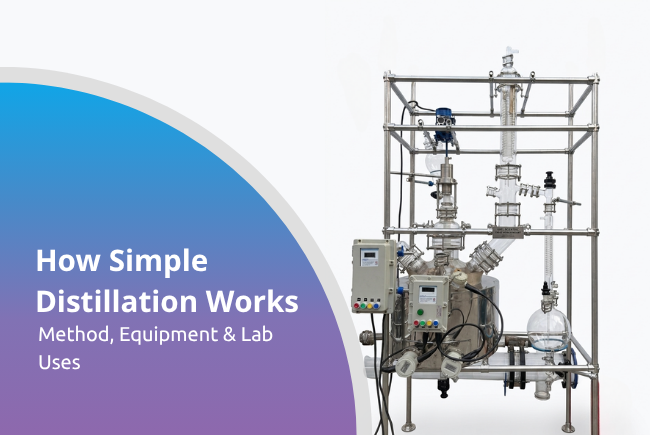
At Goel Scientific Glass Works Ltd., we offer a modular Simple Distillation Unit designed for reliable vapour-liquid separation in the laboratory. It includes a heating flask, condenser, and receiver in a compact assembly that can work under moderate vacuum conditions. Depending on process requirements, the unit is available in capacities ranging from 5 L to 100 L.
Some of the key design features include:
- Borosilicate glass construction for thermal resistance
- PTFE valves and joints for secure sealing
- Stainless steel support structures for stability
- Coil or shell-and-tube condenser options
- Standard taper joints for modular assembly
- Temperature tolerance up to approximately 200°C
The unit supports integration with utility systems, including heating mantles, vacuum pumps, and cooling systems, allowing laboratories to adapt the setup for different applications.
Simple Distillation vs Fractional Distillation
The two techniques share the same basic principle but differ in the number of separation stages they provide:
| Parameter | Simple Distillation | Fractional Distillation |
| Separation stages | Single | Multiple |
| Boiling point difference needed | More than 25°C | Small |
| Equipment complexity | Simple | Advanced |
| Maintenance | Minimal | Higher |
| Purity level | Moderate | High |
Simple distillation is preferred for simple separations where quick setup, easy cleaning, and lower operational costs are important.
Common Laboratory and Industrial Uses
Simple distillation is used across a wide range of laboratory and industrial processes, including:
- Separation of volatile compounds and solvents
- Removal of low-boiling impurities
- Solvent recovery and clean-up operations
- Distilled water production
- important oil purification
- Process development and laboratory testing
Its versatility and low maintenance make it a preferred choice for thermal separation tasks.
Safety and Operational Practices
Since distillation uses heated glassware, boiling chips or magnetic stirrers should be used to prevent sudden bumping during heating. Moreover, the apparatus should never be fully sealed, as pressure buildup can damage the system.
Operators should also stop heating before the flask becomes completely dry to avoid overheating and glass breakage. Regular inspection of joints, valves, and condensers helps maintain efficient operation and reduces the risk of leaks.
Why Precision Glassware Matters in Distillation
The consistency of simple distillation depends entirely on the quality of the glass apparatus. Borosilicate 3.3 components with accurately ground joints withstand thermal cycling and chemical attack across thousands of operating hours. At Goel Scientific Glass Works Ltd., we offer Simple Distillation Units, along with the individual flasks, condensers, and adapters that comprise them. Each component is made from certified borosilicate glass, checked against standard ground-joint specifications, and supplied to laboratories and industrial users.
Conclusion
Simple distillation is one of the most reliable and cost-effective separation techniques used in laboratories and industrial facilities. Its minimal maintenance requirements and ability to efficiently separate volatile substances make it a valuable method for purification and solvent recovery. One you understand how simple distillation works, you can choose the right equipment required for the process as per your requirements.
By using precision-engineered equipment like the Simple Distillation Unit from Goel Scientific Glass Works Ltd., you can achieve consistent performance, improved safety, and dependable results across a wide range of separation applications.
Frequently Asked Questions
Simple distillation can separate volatile liquids from dissolved solids or from liquids with significantly different boiling points.
Simple distillation is not suitable for liquids with close boiling points because it relies on a single separation stage.
A noticeable temperature increase, or the cessation of distillate dripping into the receiver, indicates that the volatile fraction has been collected.
Simple distillation can remove dissolved solids from liquids. Dissolved solids remain in the flask while the liquid evaporates and condenses separately.
The condenser cools the vapour leaving the distillation flask, condensing it back into liquid for collection.
Goel Scientific Glass Works Ltd. makes Simple Distillation Units from certified borosilicate 3.3 glass with dimensionally precise ground joints that assemble quickly and seal reliably. The standardised components are interchangeable across the product range, simplifying spare parts management and reducing setup time between batches in busy laboratory environments.
