




- GOEL Scientific
- September 21, 2026
- Vessels
- 0 Comments
Imagine launching a high-value batch synthesis, only for aggressive reagents to pit internal metal walls, introduce trace iron contaminants and ruin months of development. For chemical process engineers, material failure isn’t just an inconvenience; it is a major financial and safety risk.
This is where industrial glass equipment steps in. By providing a non-reactive, transparent processing environment, glass containment systems eliminate purity risks while giving operators real-time visual control over complex reactions.
Why Borosilicate 3.3 is the Industry Standard for Glass Vessels
Not all industrial glass is built the same. While basic soda-lime formulations fracture under mild heat, borosilicate glass vessels rely on a high concentration of boron trioxide to deliver an extremely low coefficient of thermal expansion.
This unique material profile allows borosilicate glass vessels to withstand aggressive thermal cycles and resist virtually all industrial acids, halogenated compounds and organic solvents. The smooth, non-porous surface also stops product buildup, reducing turnaround times between batch campaigns.
Types of Industrial Glass Vessels and Their Functions
Selecting the right vessel geometry directly influences fluid dynamics, thermal performance and overall operational safety.
1. Spherical vs Cylindrical Glass Vessels
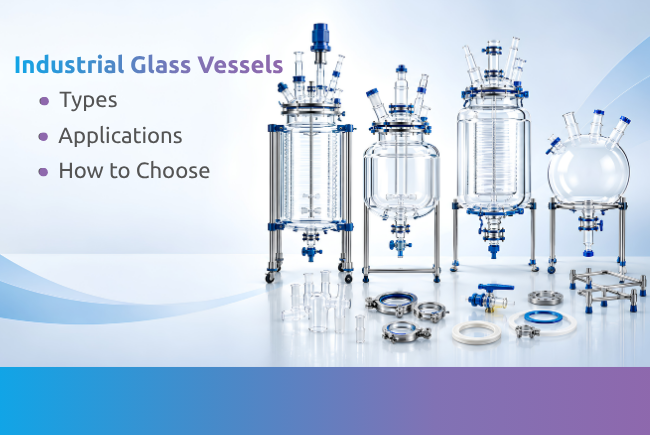
- Spherical Vessels: Featuring a rounded geometry (often called spherical jars), these units distribute internal mechanical stress evenly across their walls. They perform well under full vacuum and are widely used as receiver tanks, gas-liquid separators and feed vessels. You can add equatorial nozzles and top dip pipes for multi-port process flows.
- Cylindrical Glass Vessels: Ranging from 5 L to 500 L, cylindrical vessels simplify the integration of mechanical agitators, internal baffles and liquid dosing tubes. Their vertical profile makes them the preferred choice for batch reactors, buffer storage and liquid extraction columns.
2. Single-Wall vs Jacketed Glass Vessels
Single-wall glass vessels work well for ambient storage, gravity settling or simple feed duties. However, when a process demands precise heat input or cooling, jacketed vessels become necessary.
- Single/Double Jackets: A jacketed vessel places an outer glass or metal sleeve around the primary containment wall. Thermal fluids (such as hot oil, chilled glycol or steam) circulate through this outer cavity.
- Temperature Control: This design supports accurate isothermal conditions, rapid thermal profiling and precise crystallisation routines without exposing the process media to external heating elements.
Decanter vessels fall into another specialised category, using tapered conical bottoms or settled phase outlets to separate immiscible liquid-liquid or liquid-solid mixtures cleanly by gravity.
As a leading manufacturer of high-purity processing equipment, Goel Scientific Glass Works Ltd. engineers a full suite of spherical, cylindrical and jacketed borosilicate glass vessels. Custom-fabricated with custom nozzle layouts, flanged connections, and variable wall thicknesses, these systems scale seamlessly from R&D benches to full industrial plant operations.
Key Industrial Glass Vessel Applications in Modern Chemistry
The unique combination of transparency and chemical resistance drives varied glass vessel applications across chemical and pharmaceutical sectors:
- Reaction & Synthesis Units: Serving as the central containment chamber for corrosive API reactions, acid-catalysed syntheses and polymerisation processes.
- Distillation & Evaporation Receivers: Capturing condensed overhead fractions, high-purity solvents and aggressive reflux mixtures.
- Phase Decanting & Separation: Facilitating gravity settling of organic and aqueous phases in extraction networks.
- Feed & Buffer Containment: Holding sensitive liquid reagents at controlled temperatures before introducing them into continuous-flow loops.
- Kettle Operations: Managing high-viscosity thermal boiling, solvent stripping and concentration duties.
The Glass Vessel Selection Guide: 5 Factors to Consider
Configuring custom chemical process glass vessels requires balancing operational stress against material capabilities. Use this checklist during process planning:
- Operating Pressure & Vacuum: Spherical vessels naturally handle vacuum better than wide-flat cylindrical shapes. Always verify wall-thickness ratings against the intended operating pressure range.
- Thermal Dynamics: Calculate the required heat transfer area. If your reaction generates strong exotherms, select a baffled jacketed vessel to ensure high fluid velocity across the thermal boundary.
- Agitation and Internals: Determine whether your process needs internal baffles, dip tubes or top-entering stirrers. Cylindrical shapes offer much easier mechanical mounting for heavy-duty agitator drives.
- Port and Nozzle Requirements: Account for all feed lines, temperature probes, pressure relief valves and sampling ports before final fabrication to avoid messy retrofits.
- Structural Mounting: Glass requires dedicated support hardware. Ensure your design incorporates stress-relieving vessel holders and cushioned mounting frameworks to carry structural loads safely.
Glass vs Stainless Steel (SS) Vessels
| Performance Factor | Borosilicate Glass Vessels | Stainless Steel (316L) Vessels |
| Corrosion Resistance | Superior across almost all acids & halogens | Susceptible to pitting from chlorides & strong acids |
| Process Visibility | 100% transparent body | None (requires sight glasses) |
| Metal Contamination | Zero trace metal leaching | Risk of iron, nickel or chromium leaching |
| Cleaning Inspection | Simple visual CIP validation | Requires secondary swab testing |
| Pressure Tolerance | Moderate pressure / High vacuum | High positive pressure capabilities |
Integrating Accessories: Agitators, Valves and Measurement Tools
A glass shell needs specialised accessories to function as a process unit. Integrating precision-machined support components ensures leak-free operation and protects the glass body from mechanical strain.
The right vessels accessories selection typically covers the following categories:
- Sealing Systems: Chemically inert PTFE, Viton or FFKM gaskets prevent leaks at high-temperature joint interfaces.
- Bottom Drain Valves: Zero-dead-leg PTFE valves prevent unmixed pockets of liquid from settling in the discharge port.
- Support Structures: Spring-loaded metal support rings and cushioned mounting collars isolate the glass from structural vibrations.
- Instrumentation Assemblies: Glass-sheathed thermocouples and pressure sensors deliver accurate process data without introducing metallic contact points.
Safety and Maintenance of Large-Scale Glass Vessels
Operating large-scale industrial glass equipment safely requires disciplined maintenance routines. Regularly inspect wetted surfaces for deep scratches or internal etching caused by hydrofluoric acid or hot concentrated alkalis. Avoid rapid thermal shocks by keeping temperature shifts within recommended limits and ensure all connecting pipework features flexible expansion bellows to absorb mechanical movement.
Conclusion
Choosing the right vessel geometry, thermal jacket, and mounting accessories is fundamental to protecting batch purity, operational safety, and overall process yield. Whether you need a 5-litre pilot receiver or a 500-litre production-scale jacketed unit, precision fabrication dictates long-term performance.
Goel Scientific Glass Works Ltd. provides engineered borosilicate glass vessels, custom glass fabrications and turn-key process assemblies designed around your exact operating data. Contact our engineering team today to review your process specifications, request a custom quote or discuss your plant expansion requirements.
FAQs
Borosilicate 3.3 glass safely withstands operating temperatures up to 250°C to 300°C for continuous service, provided thermal gradients across the vessel wall remain controlled to prevent thermal stress.
No, standard industrial glass vessels are optimised for full vacuum conditions up to mild positive pressures (typically 0.5 bar to 1.0 bar depending on volume and wall thickness). High-pressure reactions require specialised metal vessels or glass-lined steel.
They provide complete chemical inertness, preventing metal leaching into sensitive active ingredients, while allowing precise temperature control and full visual confirmation of batch conditions during GMP processing.
Avoid thermal shock by controlling the rate of temperature change (typically keeping delta T under 50°C to 80°C, depending on wall thickness), using pre-heated thermal fluids in jacketed lines, and avoiding sudden cold fluid injections into hot vessels.
Borosilicate 3.3 glass resists almost all acids, organic solvents and halogenated compounds. The primary exceptions that attack glass are Hydrofluoric Acid (HF), hot concentrated Phosphoric Acid and strong hot alkaline solutions.
