




- Keyur Patel
- August 14, 2026
- Jacketed Vessel
- 0 Comments
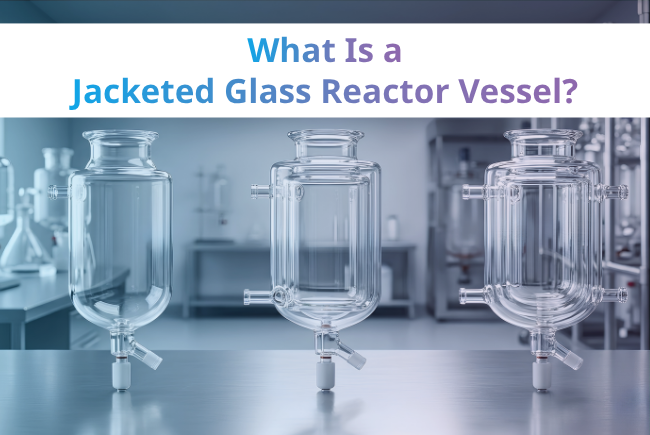
Precise temperature control is critical in many chemical, pharmaceutical, and research processes. For anyone wondering what is a jacketed glass reactor, it is a specialised borosilicate glass vessel surrounded by an external jacket through which a heat-transfer fluid circulates. The design allows operators to maintain stable reaction conditions while observing the process in real time. Due to these advantages, jacketed glass reactors are widely used in laboratories, pilot plants, and small-scale production facilities.
How Temperature-Controlled Glass Reactors Work
A reactor becomes ‘jacketed’ when an outer enclosure surrounds the main reaction chamber, allowing a heating or cooling medium to circulate around it. In glass systems, both the inner vessel and outer jacket are manufactured from borosilicate 3.3 glass, known for its excellent chemical resistance and thermal stability.
As the heat-transfer fluid flows through the jacket, it exchanges heat with the reaction mixture inside. It allows operators to maintain precise temperatures throughout the process without contaminating the product. The transparent design also makes it easy to monitor reaction progress, crystallisation, colour changes, and phase separation.
Components of a Glass Reactor Vessel
A jacketed reactor vessel consists of several essential components that work together to support safe and efficient operation:
- Inner vessel: Holds the reaction mass and provides the primary heat-transfer surface.
- Outer jacket: Surrounds the inner vessel and channels heat-transfer fluid to control temperature.
- Top cover with nozzles: Accommodates the agitator, condenser, feed lines, and instrumentation.
- Bottom discharge valve: PTFE or glass-lined valve that allows clean drainage of the product.
- Agitator and stirrer: Provides mixing, sized to the viscosity and volume of the reaction mass.
- Support structure: A stainless steel frame that supports the assembly and enables safe operation at scale.
At Goel Scientific Glass Works Ltd., we offer Jacketed Vessels that maintain the benefits of visual inspection and chemical resistance while accommodating thermal exchange. The jacket layer can be segmented, baffled, or zoned to improve thermal uniformity and reduce hotspots.
How Temperature Control is Achieved
Operation begins by charging reactants through the top cover into the inner vessel. The agitator is started, and the temperature controller is set to the required value. Heat-transfer fluid circulates continuously through the jacket, supplied by an external thermal control unit that heats or cools it as needed. Sensors in the reaction mass and at the jacket inlet and outlet feed back to the controller, which adjusts fluid temperature and flow to hold the setpoint.
The transparent borosilicate walls allow operators to observe colour changes, phase separations, and crystal formation directly, which is one of the practical advantages a jacketed reactor vessel offers over equivalent metal equipment. The visibility is a defining feature of the jacketed reactor configuration.
Types of Jacketed Glass Reactors
Selecting the right type of jacketed reactor depends on factors such as operating temperature, process requirements, and production scale. We offer the following configurations of jacketed glass reactors:
- Single-wall reactor: Designed for basic applications where external temperature control is sufficient.
- Double-jacketed reactor: The standard configuration used for synthesis, extraction, and crystallisation processes.
- Triple-walled or vacuum-jacketed reactor: Suitable for cryogenic applications that require additional insulation and low-temperature stability.
- Pressure-rated jacketed reactor: It is built to handle moderate pressure conditions for specialised chemical reactions.
- Pilot-scale jacketed reactor: Larger-capacity systems used for scale-up studies and process development before commercial production.
Choosing the appropriate reactor design at the planning stage can improve process efficiency, enhance safety, and support future scale-up requirements.
Industrial and Laboratory Applications
A glass reactor vessel is used across a wide range of industries where precise thermal control and chemical compatibility are important. Some of the common applications include:
- Pharmaceutical API synthesis
- Fine chemical manufacturing
- Polymer development
- Crystallisation studies
- Natural product extraction
- Process optimisation and scale-up
- Research and development activities
The combination of visibility, corrosion resistance, and temperature control makes these reactors particularly valuable for laboratory and pilot-scale operations.
Why Quality Matters in Glass Reactor Selection
The reliability of any reactor depends on the quality of its design and manufacturing. Factors such as uniform glass thickness, precision-engineered joints, and rigorous testing contribute to long-term performance and operational safety.
At Goel Scientific Glass Works Ltd., we offer high-quality Jacketed Vessels manufactured from certified borosilicate 3.3 glass and tested for thermal and vacuum integrity before installation. Choosing a well-engineered system can help reduce downtime, improve process consistency, and extend equipment life.
Conclusion
A jacketed reactor vessel plays an important role in laboratory and process applications by providing accurate temperature control, excellent chemical resistance, and clear visibility of the reaction environment. Whether used for research, process development, or small-scale production, selecting the right reactor configuration helps ensure safe operation, reliable results, and long-term process efficiency.
FAQs
A jacketed glass reactor is used for reactions that require precise temperature control under inert conditions. It is used for pharmaceutical API synthesis, crystallisation, extraction, polymer research, and process development at laboratory and pilot scale. The transparent walls also make it a preferred vessel for reaction visualisation and process optimisation studies.
An external thermal control unit, known as the chiller-heater, conditions the heat-transfer fluid and circulates it through the jacket at the required flow rate. Sensors in the reaction mass and at the jacket nozzles feed back to a controller that adjusts the unit’s setpoint to hold the desired reaction temperature.
A Borosilicate 3.3 glass is used to make reactors as it offers excellent resistance to thermal shock, corrosion, and aggressive chemicals. Its transparency also allows operators to monitor reactions visually, making it a preferred material for laboratory and pilot-scale reactor systems.
A jacketed glass reactor can be used for both heating and cooling by circulating different heat-transfer fluids through the jacket. The flexibility makes it suitable for processes that require precise temperature changes throughout the reaction cycle.
A jacketed glass reactor needs regular cleaning and proper handling to help maintain performance, extend equipment life, and reduce the risk of operational issues. Routine maintenance includes inspecting glass surfaces, seals, valves, and agitator components for wear or damage.
