




- Keyur Patel
- August 11, 2026
- Liquid-Liquid Extraction
- 0 Comments
Separation processes are important in chemical, pharmaceutical, petrochemical, and manufacturing industries where product purity and process reliability impact production quality. Among the most widely used techniques, liquid-to-liquid extraction offers a way to separate compounds without exposing them to high temperatures, making it suitable for heat-sensitive materials and complex mixtures.
The growing demand for high-purity processing has increased the importance of knowing what liquid extraction is, how the liquid-liquid extraction works, and which process conditions improve extraction efficiency. From solvent selection and phase separation to industrial-scale extraction systems, working depends on carefully designed equipment and optimised workflows to achieve consistent results while minimising solvent loss and operating costs.
Introduction to Liquid-Liquid Extraction
In liquid-to-liquid extraction, a compound is separated between two immiscible liquid phases. For industries handling heat-sensitive compounds or mixtures with closely related boiling points, understanding what liquid extraction is becomes important. Unlike distillation, this process operates at lower temperatures, reducing the risk of thermal degradation while improving selective separation.
The Fundamental Liquid-Liquid Extraction Principle
The liquid-liquid extraction principle is based on the transfer of a solute between two immiscible liquids, usually in an aqueous phase and an organic solvent. It depends on the partition coefficient, which determines how the compound distributes between the two phases. It is especially useful for heat-sensitive products and mixtures with closely related boiling points, for which distillation may not be suitable.
Step-by-Step Liquid Liquid Extraction Procedure
A liquid liquid extraction procedure includes the following stages:
- The feed solution and solvent are introduced into the extraction vessel.
- Both phases are mixed thoroughly to improve mass transfer.
- The mixture is allowed to settle so the liquid layers separate naturally.
- The extract phase containing the target compound is collected.
- Solvent recovery systems are used for regeneration and reuse.
This process may be repeated in multiple stages to achieve higher purity and recovery.
Types of Liquid Extraction Methods in Chemistry
Different industries use different forms of liquid extraction methods depending on process scale and application.
- Single-Stage Batch Extraction: Common in laboratories using separating funnels.
- Multi-Stage Extraction: Improves recovery by repeating the extraction with fresh solvent.
- Counter-Current Extraction: Used in industrial plants for continuous operation and better efficiency.
- Centrifugal Extraction: Uses centrifugal force for faster phase separation in emulsion-prone systems.
Choosing the right liquid extraction method improves the output while reducing solvent consumption.
Factors That Influence Extraction Efficiency
Several factors affect the performance of liquid to liquid extraction systems:
- Partition coefficient of the solute
- Solvent selection and compatibility
- Mixing intensity and contact time
- pH and temperature conditions
- Density difference between phases
Careful consideration of these parameters improves recovery efficiency and process stability.
Glassware and Equipment Used in Extraction
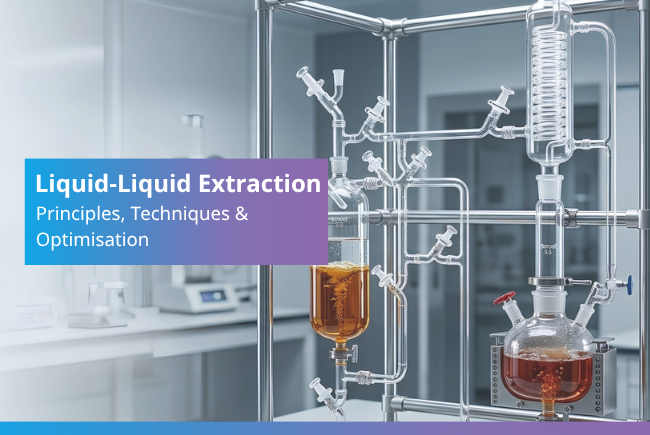
Industrial extraction systems require durable and chemically resistant equipment. At Goel Scientific Glass Works Ltd., we make specialised Liquid-Liquid Extraction Units designed for semi-batch solvent extraction operations. It includes an extraction vessel, reboiler, condenser, reflux divider, and feed piping with valves for controlled phase contact and solvent circulation. Available in 20 L, 50 L, 100 L, 200 L, and 300 L capacities, these units support efficient solvent reuse and minimal solvent loss.
The equipment is built with borosilicate glass construction, PTFE valves, and stainless steel supports, offering high visibility, corrosion resistance, and operational reliability for demanding chemical applications.
Common Challenges: Emulsions and Solvent Selection
One challenge in applying the liquid-liquid extraction principle is the formation of emulsions, which can slow phase separation and reduce efficiency. Proper mixing control and suitable equipment design help minimise this issue. The ideal solvent should provide high selectivity, easy recovery, and safe handling while maintaining process efficiency.
Industrial Applications of Liquid-Liquid Extraction
The versatility of liquid extraction can be seen across multiple industries:
- Pharmaceuticals: Recovery of APIs, antibiotics, and vitamins
- Petroleum Refining: Separation of aromatic hydrocarbons
- Hydrometallurgy: Extraction of copper and rare earth metals
- Wastewater Treatment: Removal of toxic compounds and heavy metals
- Speciality Chemicals: Purification of sensitive chemical intermediates
LLE vs Distillation: Which Process Should You Choose?
Both techniques are used to separate components of a liquid mixture but rely on different principles:
| Parameter | Distillation | Liquid-Liquid Extraction |
| Separation basis | Boiling point difference | Difference in solubility |
| Heat sensitivity | High | Low |
| Equipment complexity | Column with reboiler and condenser | Contactor with phase separation |
| Energy consumption | High | Lower |
As seen from the table, the liquid-liquid extraction principle is often preferred for heat-sensitive materials and difficult-to-separate mixtures.
Why Process Design Matters in Liquid-Liquid Extraction
Process design is important for successful liquid-to-liquid extraction because factors such as solvent circulation, extraction vessel design, and automated control systems directly affect recovery efficiency and operating costs. The extraction systems from Goel Scientific Glass Works Ltd. are designed to support controlled solvent regeneration, efficient phase separation, and reliable long-term industrial performance.
Conclusion
Understanding liquid extraction is important for industries requiring efficient, low-temperature separation methods. With the right equipment, solvent selection, and process design, liquid-to-liquid extraction offers reliable purification, lower energy consumption, and improved product quality across a wide range of industrial applications.
Looking for reliable and high-performance extraction systems for industrial processing? Explore the advanced Liquid-Liquid Extraction Units from Goel Scientific Glass Works Ltd., engineered with borosilicate glass construction, efficient solvent recovery systems, and scalable vessel capacities for demanding chemical and pharmaceutical applications.
Frequently Asked Questions
Liquid-liquid extraction separates compounds between two immiscible liquids, while solid-liquid extraction removes compounds from a solid using a solvent.
It is the ratio of solute concentration in the extract phase to the raffinate phase at equilibrium. Higher values indicate better extraction efficiency.
Since the process operates at low temperatures, it is ideal for heat-sensitive compounds such as antibiotics and natural extracts.
Some common solvents include ethyl acetate, hexane, dichloromethane, chloroform, and toluene, selected based on solubility and process requirements.
The pH affects the ionisation of compounds, which in turn affects their solubility and extraction efficiency.
The main concerns include solvent toxicity, emissions, and disposal. Many industries now prefer solvent recovery systems and greener solvent alternatives.
