




- Keyur Patel
- August 20, 2026
- Rotary Evaporator
- 0 Comments
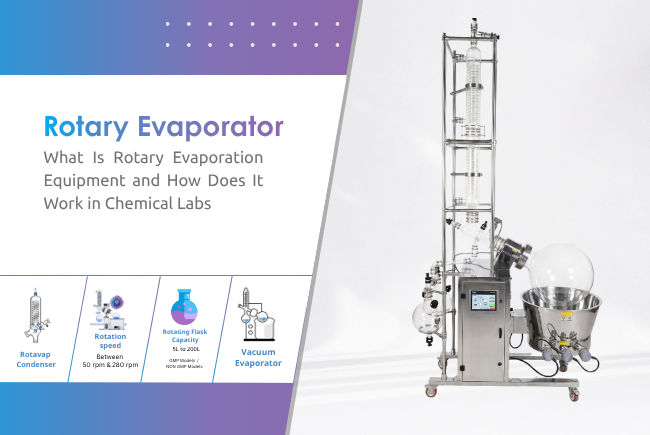
Many laboratory processes remove solvents from samples before they can be analysed, purified, or used in the next stage of production. Rotary evaporation equipment is commonly used for this task because it removes solvents quickly while helping protect heat-sensitive materials. Rotary evaporator uses include concentrating samples, recovering solvents, and preparing materials for further testing. Its simple working principle and reliable performance have made it an important piece of equipment in chemical, pharmaceutical, and research laboratories.
Role of Rotary Evaporator in Laboratory Processing
A rotary evaporator is designed to separate solvents from liquid samples under controlled conditions. The system consists of a rotating flask, a heating bath, a condenser, and a vacuum source. The sample is placed inside the evaporation flask, which rotates while sitting in a heated bath. As the flask turns, the liquid spreads into a thin layer along its inner wall. At the same time, a vacuum lowers the pressure inside the system.
Since solvents boil at lower temperatures under reduced pressure, they can be removed more gently. The solvent vapour travels to the condenser, where it condenses and returns to liquid form. The condensed solvent is then collected in a separate receiver flask, while the concentrated sample remains behind.
Components of a Rotary Evaporator
Each rotary evaporator part has a specific role in the evaporation process, as mentioned below:
- Rotating flask: Holds the sample and rotates continuously to spread the liquid into a thin film, increasing the surface area for faster evaporation.
- Heating bath: Provides gentle and controlled heat, helping the solvent evaporate efficiently without exposing the sample to excessive temperatures.
- Condenser: Cools the solvent vapour, converting it back into liquid form for collection and recovery.
- Vacuum controller: Regulates system pressure, allowing solvents to evaporate at lower temperatures and improving process control.
- Receiver flask: Collects the condensed solvent after it passes through the condenser, facilitating recovery and disposal.
These rotary evaporator parts and functional elements create a reliable system for solvent recovery, sample concentration, and other laboratory applications. At Goel Scientific Glass Works Ltd., we manufacture precision rotary vacuum evaporators or rotary film evaporators for laboratory, pilot and industrial use.
Supporting Equipment for Better Performance
Many laboratories use additional rotary evaporator accessories to improve efficiency and simplify day-to-day operation. Some of the common accessories include:
- Vacuum controllers for precise pressure control
- Cold traps to protect the vacuum pump
- Foam sensors for samples that tend to foam
- Continuous-feed systems for larger volumes
- Recirculating chillers for consistent condenser cooling
- Alternative glassware configurations for different applications
Selecting the right accessories can improve process control, increase productivity, and reduce maintenance requirements.
How Does a Rotary Evaporator Work
The rotary evaporator extraction method is used to separate valuable compounds from a solvent. A material such as plant matter or a reaction mixture is first treated with a solvent to dissolve the desired compounds. Once extraction is complete, the resulting solution is transferred to the rotary evaporator.
The solvent is then removed under controlled temperature and vacuum conditions. As the solvent evaporates and condenses, it can be collected for reuse, while the concentrated extract remains in the flask. This approach enables rapid solvent recovery and helps protect compounds that may be sensitive to excessive heat.
Applications Across Chemical and Research Laboratories
There are many examples of rotary evaporator use in laboratories. Chemists often use rotary evaporators to concentrate reaction mixtures after synthesis or purification. They are also used to remove solvents before crystallisation, chromatography, or other analytical procedures. In pharmaceutical laboratories, rotary evaporators support research, development, and quality-control activities. They are also used in natural product research, environmental testing, and academic laboratories where solvent recovery is required.
Factors to Consider Before Selecting a Rotary Evaporator
Choosing the best rotary evaporator depends on the type of work being carried out in the laboratory. Some important factors to consider include:
- Sample volume requirements
- Types of solvents being used
- Heating bath temperature range
- Condenser efficiency
- Vacuum performance
- Ease of cleaning and maintenance
- Build quality and durability
At Goel Scientific Glass Works Ltd., we manufacture rotary evaporator systems and laboratory glassware using certified borosilicate 3.3 glass. Each system undergoes testing for vacuum integrity and thermal performance before dispatch, helping laboratories achieve reliable and consistent results.
Conclusion
Rotary evaporators play an important role in laboratories that regularly work with solvents. Whether the goal is sample concentration, solvent recovery, or extract processing, the equipment offers a practical and efficient solution. Choosing a system with the right features, quality components, and suitable accessories can help laboratories achieve consistent performance and reliable results over the long term.
FAQs
Rotary evaporators can process samples such as chemical reaction mixtures, plant extracts, pharmaceutical samples, and analytical solutions. They are suitable for applications that require solvent removal, sample concentration, or solvent recovery before further processing or analysis.
A condenser improves rotary evaporator performance by cooling solvent vapours, converting them back into liquid form. Proper condensation improves solvent recovery, reduces losses, and helps maintain stable vacuum conditions throughout the evaporation process.
Evaporation speed depends on several factors, including bath temperature, vacuum level, flask rotation speed, solvent properties, and condenser efficiency. Optimising these parameters can significantly improve processing time and overall system performance.
In most laboratory settings, rotary evaporator accessories are worth the extra investment. Vacuum controllers, recirculating chillers, and cold traps are the rotary evaporator accessories that pay back fastest by improving reproducibility, protecting the vacuum pump, and reducing operator attention required during each run.
Routine maintenance should be carried out as per the manufacturer's recommendations. Regular inspection of seals, glassware, vacuum connections, and moving components helps maintain efficiency, prevent unexpected downtime, and extend the equipment's service life.
