




- GOEL Scientific
- September 16, 2026
- Heat Exchangers
- 0 Comments
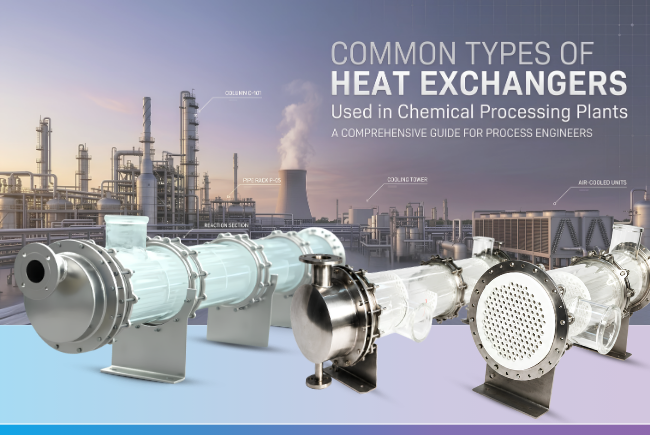
Heat exchangers are essential in chemical plants for heating, cooling, condensing and recovering heat from process streams. The right equipment helps maintain process temperatures, improve energy efficiency and reduce the risk of contamination or material failure.
Selecting from different heat exchanger types depends on factors such as fluid properties, operating temperature, pressure, corrosion risk, heat-transfer requirements and available space. Common options include shell and tube, plate, coil-in-shell and glass heat exchangers.
Types of Heat Exchangers by Construction and Flow
Heat exchangers can be classified based on their construction and how fluids move through them.
- Shell and Tube Heat Exchangers: A tube bundle is enclosed inside a cylindrical shell. One fluid flows through the tubes while another flows around them on the shell side.
- Plate Heat Exchangers: Corrugated plates provide a large heat-transfer area in a compact design. They are commonly used where space is limited.
- Coil-in-Shell Heat Exchangers: Coiled tubes are placed inside a vessel and are suitable for heating, cooling and vapour condensation.
- Glass Heat Exchangers: Borosilicate glass construction offers strong resistance to many corrosive chemicals and provides clear visibility of the process.
- Counter-Current Flow: The two fluids move in opposite directions, generally providing an effective temperature driving force.
- Co-Current and Cross-Flow: Fluids move in the same direction or at right angles. These arrangements are selected based on process requirements and equipment layout.
Shell and Tube Heat Exchanger for Industrial Applications
The shell and tube heat exchanger is widely used in chemical processing because of its robust construction and flexibility. It consists of tubes enclosed within a shell. The process fluid passes through the tubes, while the second fluid flows around the tubes.
Baffles can be used on the shell side to control flow and increase turbulence, improving heat transfer. Shell and tube designs are suitable for a wide range of applications, including process heating, cooling, condensation and heat recovery.
Material selection is important when handling corrosive fluids. Depending on the application, tubes and other wetted components may be made from stainless steel, specialised alloys, glass or other chemically resistant materials.
Why Use a Borosilicate Glass Heat Exchanger?
A borosilicate glass heat exchanger is used when chemical resistance, product purity and process visibility are important. Borosilicate glass is resistant to many acids, solvents and other aggressive chemicals, making it suitable for demanding chemical and pharmaceutical applications.
Glass construction can also reduce the risk of metal contamination in processes where product purity is critical. Its transparent design allows operators to observe the process and identify issues such as fouling, deposits, phase changes or fluid colour changes.
However, glass equipment has pressure and temperature limitations and must be selected according to the specific process conditions. Proper design and installation are essential for safe operation.
Glass vs Metal Heat Exchangers
Choosing a process equipment heat exchanger involves comparing material compatibility, pressure requirements, maintenance needs and process conditions.
| Parameter | Glass Heat Exchanger | Metal Heat Exchanger |
| Chemical resistance | High resistance to many corrosive chemicals | Depends on the selected alloy |
| Process visibility | Transparent construction allows visual inspection | Opaque construction |
| Metal contamination | Low risk from metallic contact | Possible depending on material and process |
| Pressure capability | Suitable within specified design limits | Available for a wide range of pressures |
| Surface characteristics | Smooth, non-porous surface | Depends on material and finish |
| Typical use | Corrosive and high-purity processes | General industrial and utility applications |
The choice should be based on the chemical composition, temperature, pressure and purity requirements of the process rather than material type alone.
Key Factors for Selecting a Chemical Plant Heat Exchanger
Selecting a chemical plant heat exchanger requires more than calculating heat duty. The following factors should be considered:
- Material Compatibility: The heat-transfer surface must withstand the process fluid and operating conditions.
- Thermal Duty: Heat-transfer area should be calculated using the required duty, flow rates, temperatures and temperature difference.
- Pressure Drop: Excessive pressure loss can increase pumping requirements and operating costs.
- Fouling: Deposits can reduce heat-transfer efficiency. The exchanger design should support the required cleaning method.
- Space and Installation: Equipment dimensions, orientation, access and piping requirements should fit the plant layout.
- Maintenance: Components such as gaskets, tubes and joints should be accessible for inspection and servicing.
Role of Heat Exchangers in Industrial Cooling Systems
Heat exchangers play an important role in industrial cooling systems by removing excess heat from reactors, process streams and equipment. They can help maintain stable operating temperatures and improve energy recovery.
In chemical applications, the exchanger material is especially important. Corrosive fluids may require glass or specialised alloys, while utility services may be handled by conventional metal equipment.
Glass exchangers can also offer process visibility, which can help operators identify changes in fluid condition or possible leakage during operation.
Maintaining an Industrial Heat Exchanger
Regular maintenance helps maintain heat-transfer performance and extend equipment life. Maintenance requirements vary by design and process, but commonly include:
- Inspecting tubes, tube sheets and baffles for deposits or damage.
- Monitoring pressure drop to identify possible fouling.
- Checking gaskets, seals and joints for leakage.
- Cleaning deposits using methods compatible with the equipment material.
- Inspecting glass components for cracks, chips or other damage.
Following the manufacturer’s maintenance recommendations is important, particularly for glass equipment operating under vacuum, pressure or elevated temperatures.
Choosing a Heat Exchanger Manufacturer in India
Selecting a reliable heat exchanger manufacturer in India is important when the application involves corrosive chemicals, high-purity products or specialised operating conditions. The manufacturer should understand the process requirements and recommend suitable construction materials, dimensions, flow arrangements and safety limits.
Goel Scientific Glass Works Ltd. manufactures borosilicate 3.3 glass process equipment for chemical and pharmaceutical applications. Its product range includes glass heat exchangers and other process systems designed around specific process requirements.
Conclusion
The right heat exchanger improves temperature control, process efficiency and equipment reliability. Shell and tube heat exchangers are widely used for general industrial duties, while plate and coil designs offer advantages for specific applications.
For corrosive and high-purity processes, a glass heat exchanger made from borosilicate glass can provide strong chemical resistance and process visibility. The final selection should always consider temperature, pressure, fluid compatibility, heat duty, fouling and maintenance requirements.
Choosing the right industrial heat exchanger and working with an experienced manufacturer can help support safe, reliable and efficient plant operation.
FAQs
Common heat exchanger types include shell and tube, plate, coil-in-shell and glass heat exchangers. Selection depends on heat duty, fluid properties, pressure, temperature and space limitations.
A borosilicate glass heat exchanger offers high resistance to many corrosive chemicals and provides process visibility. It is commonly considered for chemical and pharmaceutical applications where material compatibility and purity are important.
Yes. A shell and tube heat exchanger can handle corrosive fluids when suitable construction materials are selected. Borosilicate glass and specialised alloys may be used depending on the process conditions.
Industrial cooling systems use heat exchangers to transfer excess heat from process fluids, reactors and equipment to a cooling medium. This helps maintain required operating temperatures and improves process stability.
Key factors include heat duty, temperature, pressure, fluid compatibility, pressure drop, fouling, cleaning requirements, installation space and maintenance access.
Look for a heat exchanger manufacturer in India with relevant experience, material expertise, testing capabilities and the ability to design equipment around specific process conditions.
