




- Keyur Patel
- September 2, 2026
- Wiped Film Evaporator
- 0 Comments
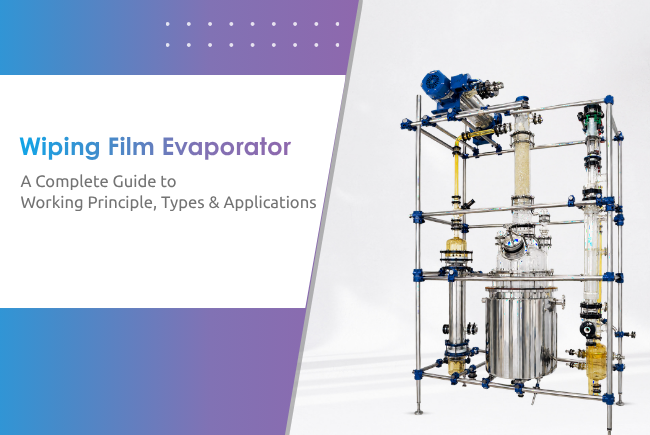
A Wiping Film Evaporator, also known as a thin-film or wiped-film evaporator, is one of the most efficient thermal separation systems for processing heat-sensitive, viscous, and high-boiling materials. The wiped film evaporator working principle is based on spreading the feed into a thin, continuously renewed film over a heated surface, enabling rapid evaporation while minimising thermal degradation. It is used across the pharmaceutical, chemical, food, and speciality manufacturing industries because it offers excellent heat transfer, short residence times, and consistent product quality. For these, GOEL introduces a specially designed range of Evaporators made of Borosilicate Glass. The range varies from laboratory size (80DN) to production plants (300DN).
Overview of Thin-Film Evaporation Technology
A Wiping Film Evaporator includes a vertical heated cylinder equipped with a rotating internal wiper assembly. The feed material enters through the top and is distributed evenly onto the inner wall of the evaporator. As the rotor turns, the wipers spread the liquid into a thin film across the heated surface, maximising heat transfer and resulting in evaporation. The generated vapours move toward a condenser, while the concentrated product exits through the bottom discharge.
How Thin-Film Separation Takes Place Under Vacuum
The wiped film evaporator working principle combines efficient heat transfer with extremely short residence times. When feed enters the evaporator, rotating wipers continuously renew the liquid film on the heated wall. The constant movement removes thermal resistance and exposes fresh product to the heating surface. At the same time, vacuum conditions lower the material’s boiling point, allowing evaporation at significantly lower temperatures.
Since the product remains in the heated zone for only a few seconds, the risk of thermal degradation is reduced. This makes the technology highly useful when working with sensitive compounds, viscous materials, and high-boiling substances.
Elements Behind Efficient Thermal Separation
The unit is constructed in Borosilicate Glass, with the jacketed pipe size designating each model. Available configurations cover laboratory to production scale:
| Model | Size DN (mm) | HTA (m²) |
| WFE3 | 80 | 0.35 |
| WFE4 | 100 | 0.47 |
| WFE6 | 150 | 0.70 |
| WFE9 | 225 | 1.06 |
| WFE12 | 300 | 1.41 |
Selecting the Right Wiped Film Evaporator
A glass wiped-film evaporator is preferred in laboratory and pilot-scale environments because it offers excellent chemical resistance and lets operators visually monitor the process. Stainless steel systems are commonly used for large-scale production, while specialised alloy constructions such as Hastelloy are chosen for highly corrosive applications.
On the other hand, a conventional wiped-film evaporator is mainly used for solvent recovery and concentration under moderate vacuum conditions. Short-path systems incorporate an internal condenser and are usually selected for deep-vacuum applications involving very high-boiling materials.
Applications of Wiping Film Evaporators
The wiped film evaporator is suitable for a wide range of industries as it works under controlled temperature and vacuum conditions. In pharmaceutical manufacturing, it is commonly used for API concentration, purification, and solvent recovery. Chemical producers rely on the technology to separate high-boiling compounds and recover valuable solvents. Natural extracts such as essential oils, vitamins, and botanical compounds can be processed with minimal thermal damage.
The technology is also used in polymer processing for devolatilisation and residual solvent removal, as well as in food and beverage applications where flavour compounds and specialty ingredients require gentle concentration.
Important Checks Before Purchasing Pre-Owned Equipment
A used wiped film evaporator can offer significant cost savings, but careful evaluation is essential before making a purchase. The rotor and wiper assembly should be inspected thoroughly, as worn components can reduce evaporation efficiency. Vacuum seals, heating jackets, and condensers should also be checked for wear or damage. Reviewing maintenance records and ensuring the availability of replacement parts can help minimise future operational risks.
Choosing equipment with a documented service history often provides greater confidence in long-term performance. At Goel Scientific Glass Works Ltd., we have decades of experience in manufacturing scientific glassware and advanced process systems for research, pharmaceutical, and chemical industries.
Why Choose a Wiped Film Evaporator From Us?
For pharmaceutical and specialty chemical applications, equipment design has a direct impact on product quality and process efficiency. At Goel Scientific Glass Works Ltd., we manufacture glass wiped film evaporator systems using Borosilicate 3.3 glass and PTFE contact components. These materials offer excellent chemical resistance and help maintain product purity throughout the evaporation process. These features allow users to achieve efficient thermal separation while maintaining control over sensitive processes.
Conclusion
A Wiping Film Evaporator provides an effective solution for processing heat-sensitive, viscous, and high-boiling materials. By combining efficient heat transfer, vacuum operation, and short residence times, the wiped film evaporator’s operating principle enables gentle, highly efficient thermal separation. Whether the application involves pharmaceuticals, specialty chemicals, natural extracts, or research-scale processing, selecting a well-designed system is essential to achieving reliable results.
Looking for a Reliable Wiping Film Evaporation Solution? Goel Scientific Glass Works Ltd. offers high-performance glass wiped film evaporator systems designed for laboratory and pilot-scale applications. Contact our team to discuss your process requirements and find the right system for your application.
FAQs
Wiping Film Evaporators can process heat-sensitive liquids, viscous products, natural extracts, pharmaceutical intermediates, polymers, and specialty chemicals. The short residence times make them suitable for materials that may degrade under prolonged heating.
Vacuum operation is important in wiping film evaporation as it lowers the boiling point of the feed material, allowing evaporation at reduced temperatures. It helps protect temperature-sensitive compounds while improving separation efficiency and reducing the risk of thermal degradation.
A glass wiped-film evaporator benefits laboratory applications by providing chemical resistance and enabling visual monitoring of the process. The visibility is useful during research, development, and pilot-scale studies where process observation is important.
A wiped film evaporator can handle highly viscous materials as the rotating wiper system continuously spreads and renews the product film. It allows the equipment to process highly viscous materials that may be difficult to handle using conventional evaporation technologies.
You should check the condition of the rotor, wiper blades, seals, heating jacket, and condenser. It is also suggested to review maintenance history, spare-part availability, and overall vacuum performance before making a purchase decision.
